each particle in gas a and gas b has the same mass. the particles in gas a are moving at a higher average…
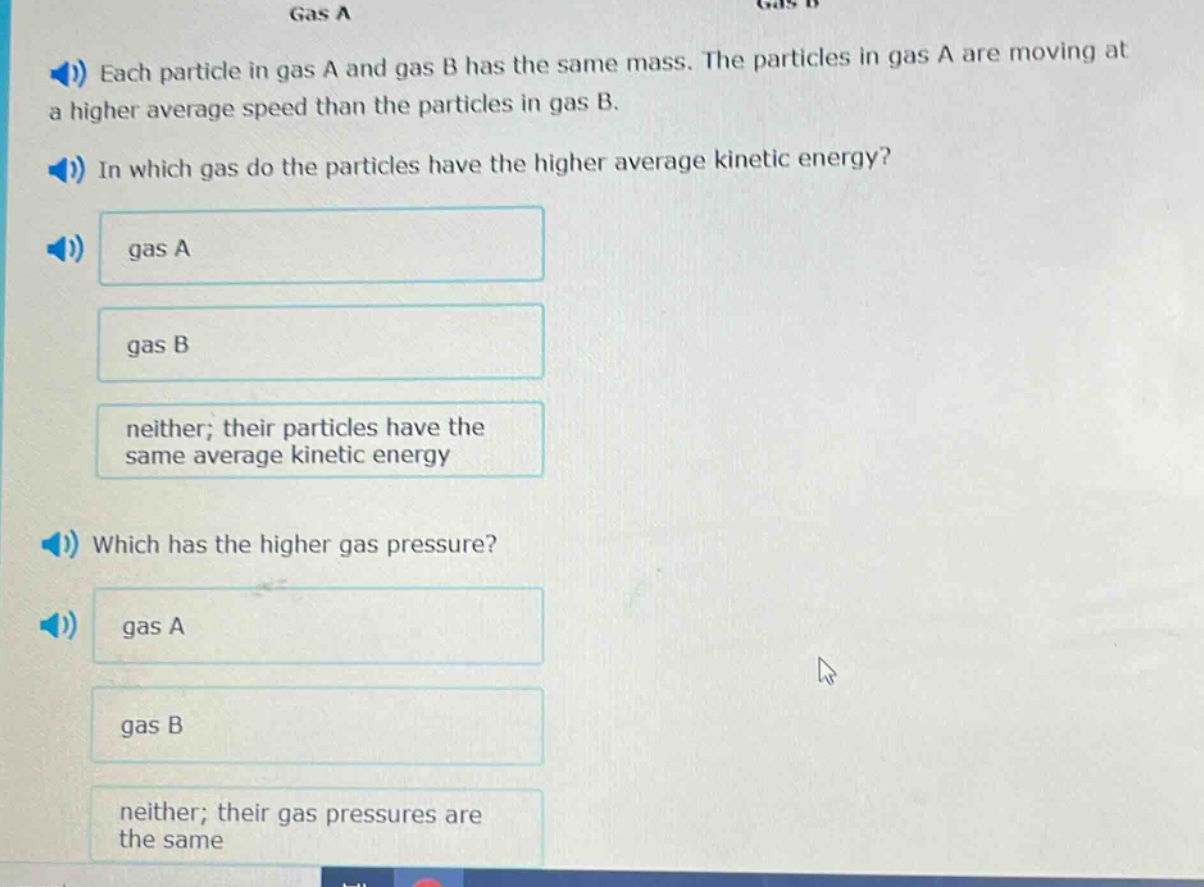
each particle in gas a and gas b has the same mass. the particles in gas a are moving at a higher average speed than the particles in gas b.\nin which gas do the particles have the higher average kinetic energy?\ngas a\ngas b\nneither; their particles have the same average kinetic energy\nwhich has the higher gas pressure?\ngas a\ngas b\nneither; their gas pressures are the same
Answer
Explanation:
Step1: Recall kinetic - energy formula
The average kinetic energy of a gas particle is given by $K_{avg}=\frac{3}{2}kT$ and also $K_{avg}=\frac{1}{2}mv^{2}$. Since the mass $m$ is the same for both gases and the particles in gas A have a higher average speed $v$, from $K_{avg}=\frac{1}{2}mv^{2}$, gas A has a higher average kinetic energy.
Step2: Recall pressure - kinetic - theory relation
The pressure of a gas is related to the average kinetic energy of its particles. Higher average kinetic energy of particles means more frequent and more forceful collisions with the walls of the container. Since gas A has particles with higher average kinetic energy, gas A has a higher pressure.
Answer:
- gas A
- gas A