each particle in sample a has less mass than each particle in sample b. all of the particles are moving at…
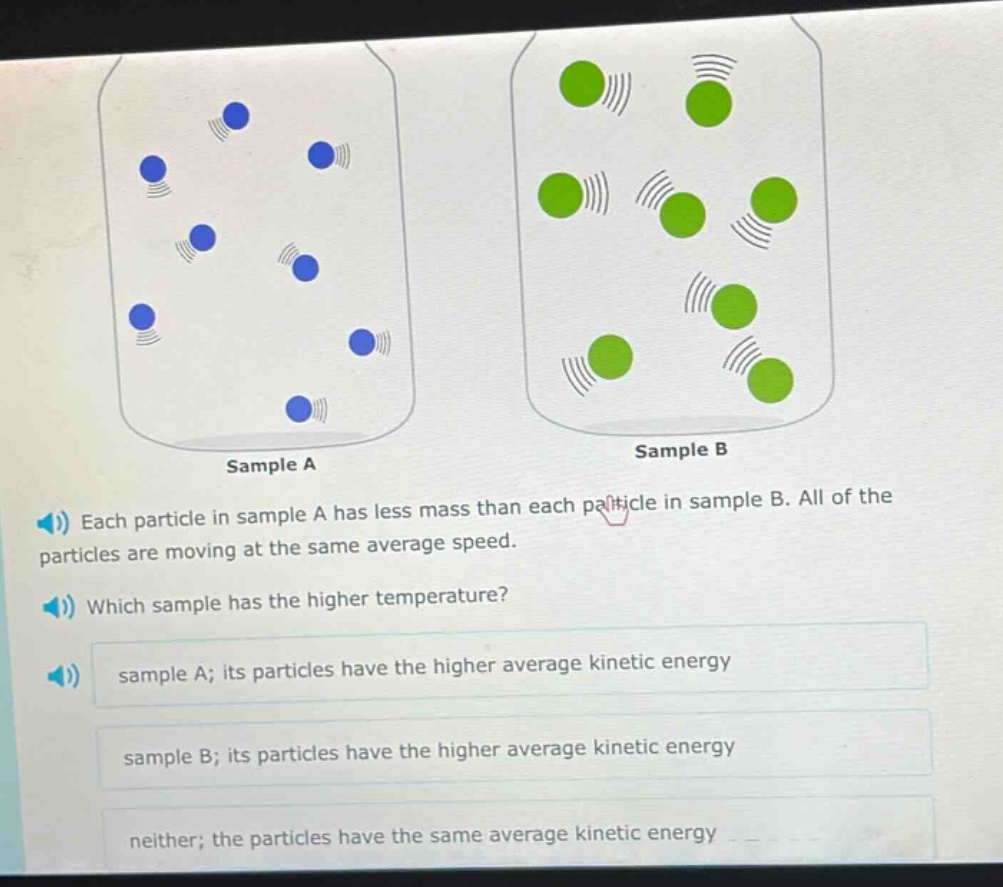
each particle in sample a has less mass than each particle in sample b. all of the particles are moving at the same average speed. which sample has the higher temperature? sample a; its particles have the higher average kinetic energy sample b; its particles have the higher average kinetic energy neither; the particles have the same average kinetic energy
Answer
Explanation:
Step1: Recall kinetic - energy formula
The average kinetic energy of a particle is given by $K_{avg}=\frac{3}{2}kT$ (where $k$ is the Boltzmann constant and $T$ is the temperature), and also $K=\frac{1}{2}mv^{2}$. Given that the average speed $v$ is the same for particles in both samples, and $m_A<m_B$.
Step2: Compare average kinetic energies
Using $K = \frac{1}{2}mv^{2}$, since $v$ is the same and $m_A<m_B$, we have $K_{A - avg}<K_{B - avg}$ for individual particles.
Step3: Relate kinetic energy to temperature
Since $K_{avg}=\frac{3}{2}kT$, a higher average kinetic energy means a higher temperature. Since $K_{B - avg}>K_{A - avg}$, sample B has a higher temperature.
Answer:
sample B; its particles have the higher average kinetic energy