at $t = 0$ a particle starts at rest and moves along a line in such a way that at time $t$ its acceleration…
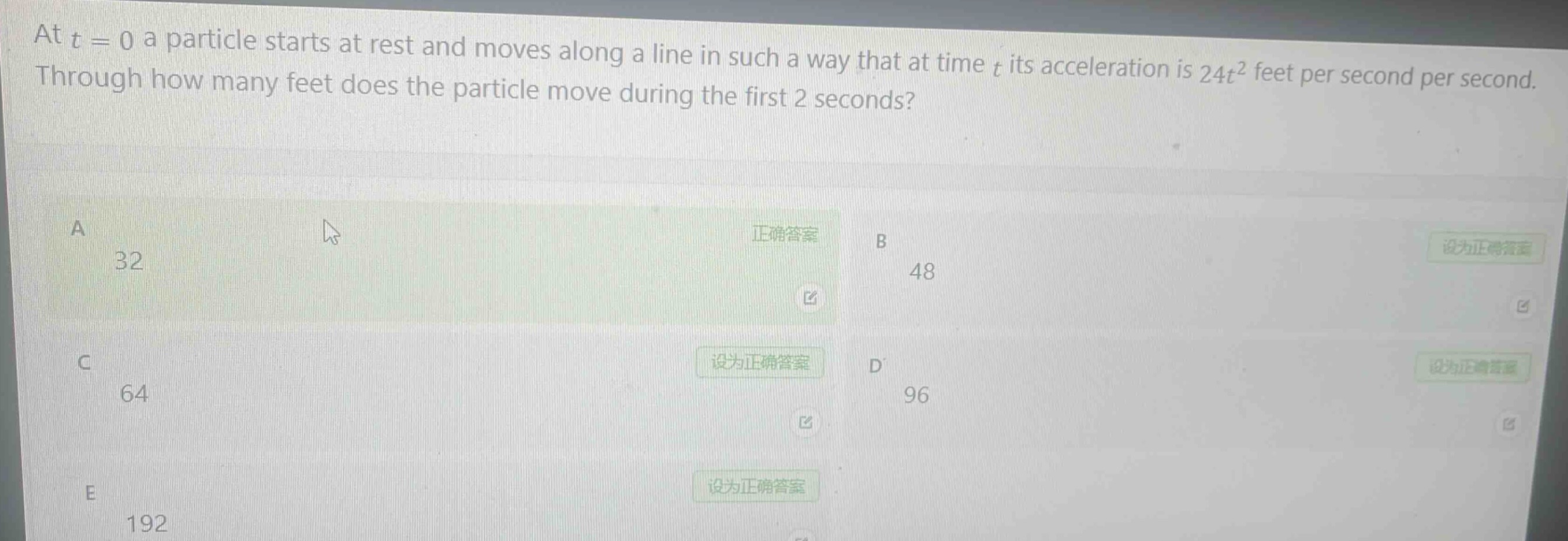
at $t = 0$ a particle starts at rest and moves along a line in such a way that at time $t$ its acceleration is $24t^{2}$ feet per second per second. through how many feet does the particle move during the first 2 seconds?\na 32\nb 48\nc 64\nd 96\ne 192
Answer
Explanation:
Step1: Find velocity function
We know that acceleration $a(t)=24t^{2}$, and velocity $v(t)$ is the antiderivative of acceleration. Using the power - rule for integration $\int x^{n}dx=\frac{x^{n + 1}}{n+1}+C$ ($n\neq - 1$), we have $v(t)=\int a(t)dt=\int24t^{2}dt = 24\times\frac{t^{3}}{3}+C=8t^{3}+C$. Since the particle starts at rest, $v(0) = 0$. Substituting $t = 0$ and $v(0)=0$ into $v(t)$, we get $0=8\times0^{3}+C$, so $C = 0$. Thus, $v(t)=8t^{3}$.
Step2: Find position function
Position $s(t)$ is the antiderivative of velocity. So $s(t)=\int v(t)dt=\int8t^{3}dt=8\times\frac{t^{4}}{4}+D = 2t^{4}+D$. Assuming $s(0) = 0$ (starting position), then $D = 0$ and $s(t)=2t^{4}$.
Step3: Calculate displacement in first 2 seconds
We want to find the displacement from $t = 0$ to $t = 2$. Using the fundamental theorem of calculus, $s(2)-s(0)$. Substitute $t = 2$ into $s(t)$: $s(2)=2\times2^{4}=2\times16 = 32$ and $s(0)=0$. So the particle moves 32 feet in the first 2 seconds.
Answer:
A. 32