the particles in both solids and liquids are arranged close together. but when a substance is a liquid, its…
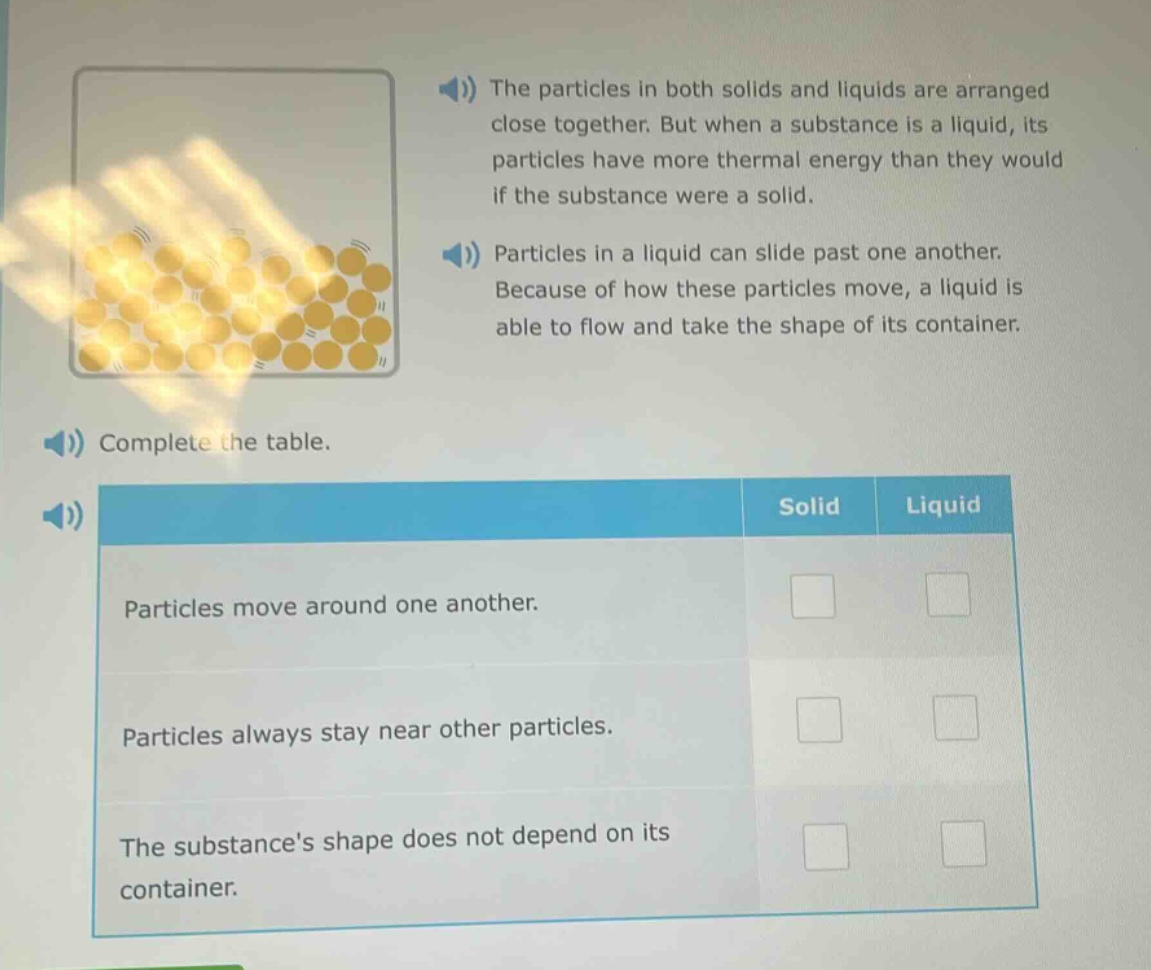
the particles in both solids and liquids are arranged close together. but when a substance is a liquid, its particles have more thermal energy than they would if the substance were a solid. particles in a liquid can slide past one another. because of how these particles move, a liquid is able to flow and take the shape of its container. complete the table. solid liquid particles move around one another. particles always stay near other particles. the substances shape does not depend on its container.
Answer
Explanation:
Step1: Analyze particle movement
Particles in a liquid can slide past one - another, so they move around one another. In a solid, particles vibrate in place but don't move around one another. So for "Particles move around one another", Solid: No, Liquid: Yes.
Step2: Consider particle proximity
Particles in both solids and liquids are arranged close together. So for "Particles always stay near other particles", Solid: Yes, Liquid: Yes.
Step3: Think about shape - container relationship
A solid has a definite shape that does not depend on its container, while a liquid takes the shape of its container. So for "The substance's shape does not depend on its container", Solid: Yes, Liquid: No.
Answer:
| Solid | Liquid | |
|---|---|---|
| Particles move around one another | No | Yes |
| Particles always stay near other particles | Yes | Yes |
| The substance's shape does not depend on its container | Yes | No |