the people are classified according to political affiliation (\democrat\, \republican\, or \independent\)…
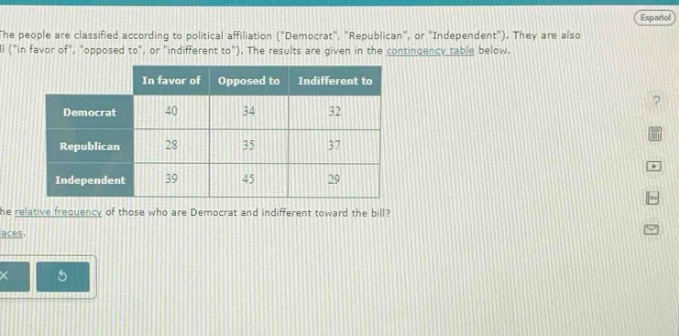
the people are classified according to political affiliation (\democrat\, \republican\, or \independent\). they are also classified according to their opinion on a bill (\in favor of\, \opposed to\, or \indifferent to\). the results are given in the contingency table below.\n| | in favor of | opposed to | indifferent to |\n|--|--|--|--|\n| democrat | 40 | 34 | 32 |\n| republican | 28 | 35 | 37 |\n| independent | 39 | 45 | 29 |\nwhat is the relative frequency of those who are democrat and indifferent toward the bill?
Answer
Explanation:
Step1: Calculate total number of people
$40 + 34+32 + 28+35 + 37+39+45+29=329$
Step2: Find number of Democrats indifferent to the bill
The number of Democrats indifferent to the bill is 32.
Step3: Calculate relative - frequency
Relative frequency = $\frac{\text{Number of Democrats indifferent}}{\text{Total number of people}}=\frac{32}{329}\approx0.0973$
Answer:
$\frac{32}{329}\approx0.0973$