the period of a pendulum is given by the equation $t = 2pisqrt{\frac{l}{g}}$, where $l$ is the length of the…
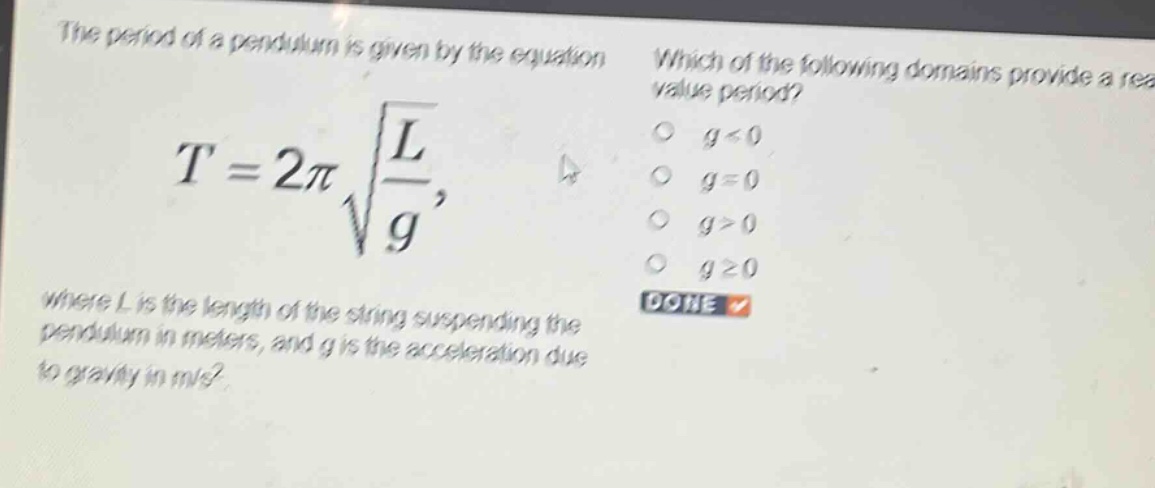
the period of a pendulum is given by the equation $t = 2pisqrt{\frac{l}{g}}$, where $l$ is the length of the string suspending the pendulum in meters, and $g$ is the acceleration due to gravity in m/s². which of the following domains provide a real - value period? $g < 0$ $g = 0$ $g>0$ $ggeq0$ done
Answer
Answer:
C. ( g > 0 )
Explanation:
Step 1: Analyze the square root requirement
For ( T ) to be real, the expression inside the square root must be non-negative: ( \frac{L}{g} \geq 0 ).
Step 2: Consider physical constraints
Length ( L ) is always positive (( L > 0 )), so the fraction ( \frac{L}{g} ) is non-negative only if ( g > 0 ) (since ( g = 0 ) makes the denominator zero, which is undefined).