phobos orbits mars in 27,553 s at a distance of 9.378×10^6 m. what is the mass of mars?\n2.58×10^11…
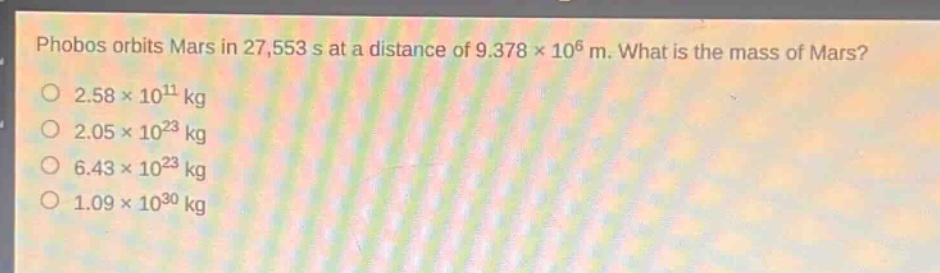
phobos orbits mars in 27,553 s at a distance of 9.378×10^6 m. what is the mass of mars?\n2.58×10^11 kg\n2.05×10^23 kg\n6.43×10^23 kg\n1.09×10^30 kg
Answer
Explanation:
Step1: Recall the formula for orbital motion
The centripetal force for the satellite (Phobos) in orbit around Mars is provided by the gravitational force. So, $F_{c}=F_{g}$. The centripetal - force formula is $F_{c}=m\frac{v^{2}}{r}$ and the gravitational - force formula is $F_{g}=G\frac{Mm}{r^{2}}$, where $m$ is the mass of Phobos, $M$ is the mass of Mars, $r$ is the orbital radius, $v$ is the orbital speed, and $G = 6.67\times10^{-11}\ m^{3}kg^{-1}s^{-2}$ is the gravitational constant. Equating them gives $m\frac{v^{2}}{r}=G\frac{Mm}{r^{2}}$, and after canceling out $m$ and rearranging, we get $M=\frac{v^{2}r}{G}$.
Step2: Find the orbital speed
The orbital speed $v$ of Phobos can be calculated using the formula $v=\frac{2\pi r}{T}$, where $T$ is the orbital period. Given $T = 27553\ s$ and $r=9.378\times 10^{6}\ m$. So, $v=\frac{2\pi\times9.378\times 10^{6}}{27553}$. $v=\frac{2\times3.14\times9.378\times 10^{6}}{27553}\approx2152.7\ m/s$.
Step3: Calculate the mass of Mars
Substitute $v\approx2152.7\ m/s$, $r = 9.378\times 10^{6}\ m$, and $G = 6.67\times10^{-11}\ m^{3}kg^{-1}s^{-2}$ into the formula $M=\frac{v^{2}r}{G}$. $M=\frac{(2152.7)^{2}\times9.378\times 10^{6}}{6.67\times10^{-11}}$. First, calculate $(2152.7)^{2}=2152.7\times2152.7 = 4633317.29$. Then, $4633317.29\times9.378\times 10^{6}=4633317.29\times9.378\times10^{6}\approx4.34\times10^{13}$. Finally, $M=\frac{4.34\times10^{13}}{6.67\times10^{-11}}\approx6.43\times 10^{23}\ kg$.
Answer:
$6.43\times 10^{23}\ kg$