in a physics class, the teacher proposes that the velocity of a car in miles per hour and the stopping…
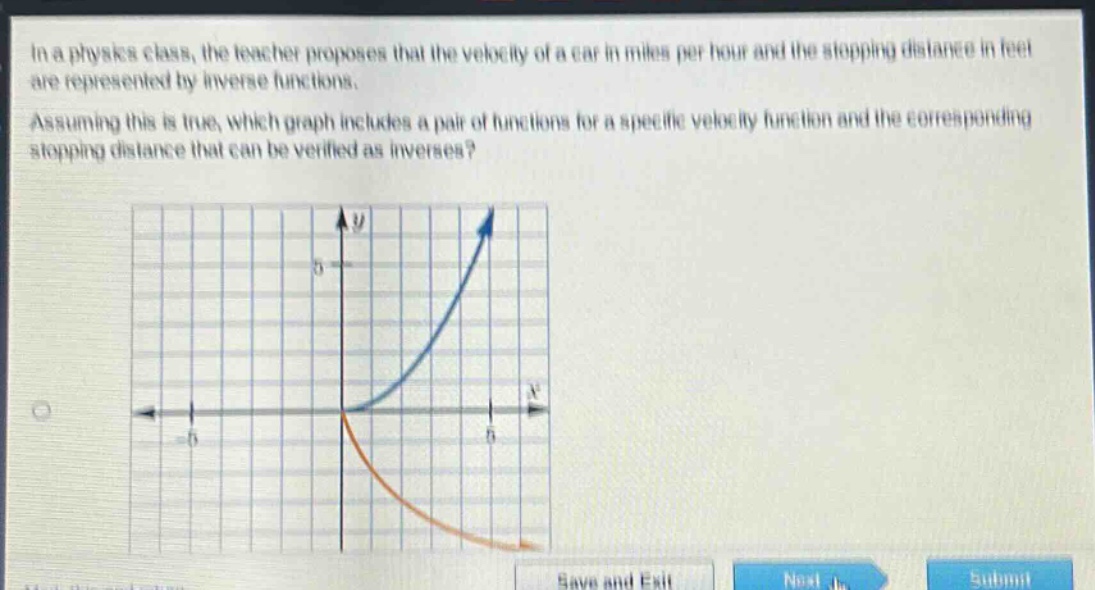
in a physics class, the teacher proposes that the velocity of a car in miles per hour and the stopping distance in feet are represented by inverse functions. assuming this is true, which graph includes a pair of functions for a specific velocity function and the corresponding stopping distance that can be verified as inverses?
Answer
Explanation:
Step1: Recall inverse - function property
The graphs of inverse functions are reflections of each other across the line (y = x).
Step2: Analyze the given graph
We need to check if the two functions in the graph are symmetric about the line (y=x). Visually, for two functions (f(x)) and (f^{-1}(x)), if ((a,b)) is on (y = f(x)), then ((b,a)) is on (y=f^{-1}(x)). When we consider the line (y = x) as the axis of symmetry, we can verify if the two curves in the graph satisfy this property.
Answer:
Without seeing all the options, we cannot give a definite answer. But the correct graph should have the two functions (velocity and stopping - distance functions) symmetric about the line (y = x). If this is the only graph provided, we would need to check if for every point ((x_1,y_1)) on one curve, there is a corresponding point ((y_1,x_1)) on the other curve with respect to the line (y=x).