this picture represents the electric field diagram between two particles with static charges. do the two…
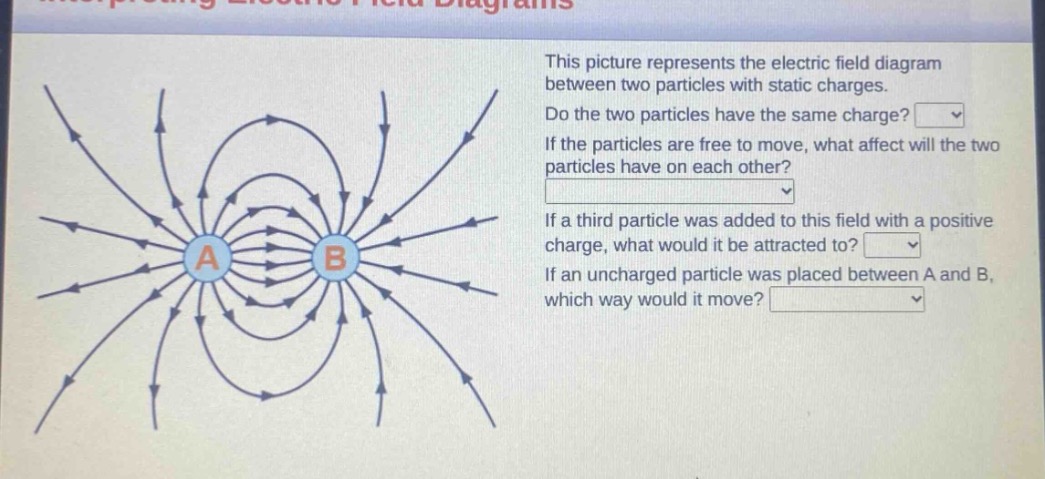
this picture represents the electric field diagram between two particles with static charges. do the two particles have the same charge? if the particles are free to move, what affect will the two particles have on each other? if a third particle was added to this field with a positive charge, what would it be attracted to? if an uncharged particle was placed between a and b, which way would it move?
Answer
Explanation:
Step1: Analyze charge from field lines
Electric field lines start from positive charges and end at negative charges. Here, field lines go from one particle to the other, so they have opposite charges. Answer to first question is No.
Step2: Determine force between particles
Oppositely - charged particles attract each other. So if free to move, they will move towards each other.
Step3: Analyze third - particle behavior
A positive charge is attracted to a negative charge. Since the field lines suggest one of the original particles is negative, the positive third - particle will be attracted to the negatively - charged particle among A and B.
Step4: Analyze uncharged particle behavior
An uncharged particle experiences no force in an electric field. So it will not move.
Answer:
- No
- They will attract each other and move towards each other.
- The negatively - charged particle among A and B.
- It will not move.