a pigeon is flying north at 40 mph, but the wind is blowing 20° south of west at 18 mph. which vector…
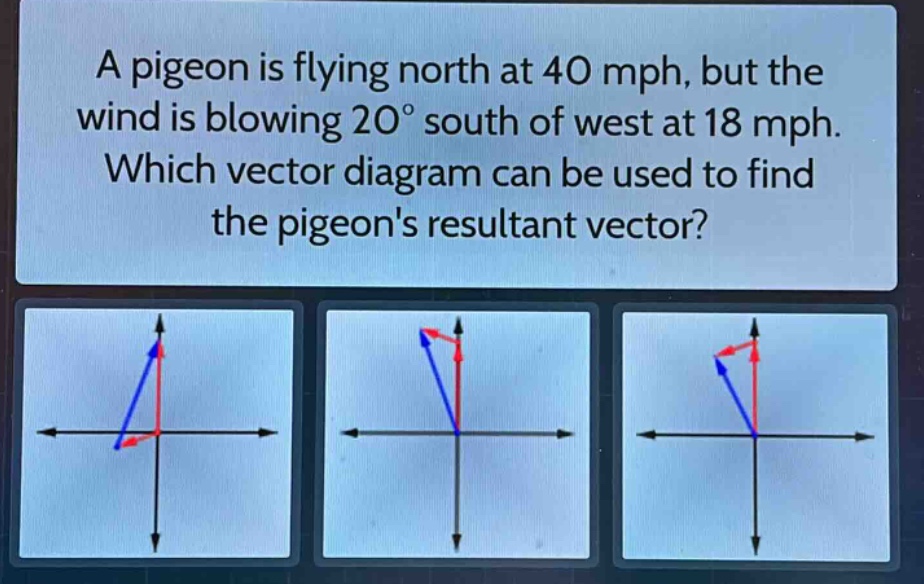
a pigeon is flying north at 40 mph, but the wind is blowing 20° south of west at 18 mph. which vector diagram can be used to find the pigeons resultant vector?
Answer
Explanation:
Step1: Analyze pigeon's velocity
The pigeon is flying north at 40 mph, so its velocity vector is a vertical - upward vector (assuming north is up).
Step2: Analyze wind's velocity
The wind is blowing 20° south of west at 18 mph. So the wind vector should be in the south - west quadrant at an angle of 20° from the west direction.
Step3: Determine resultant vector diagram
The resultant vector is found by adding the pigeon's velocity vector and the wind's velocity vector. The correct diagram will have the north - moving pigeon vector and the south - west moving wind vector with their tails at the origin and the resultant vector drawn from the tail of the vectors to the tip of the combined vectors. The second diagram is correct as it has a vertical (north - moving) vector for the pigeon and a vector in the south - west quadrant for the wind.