a pigeon is flying north at 40 mph, but the wind is blowing 20° south of west at 18 mph. what is the…
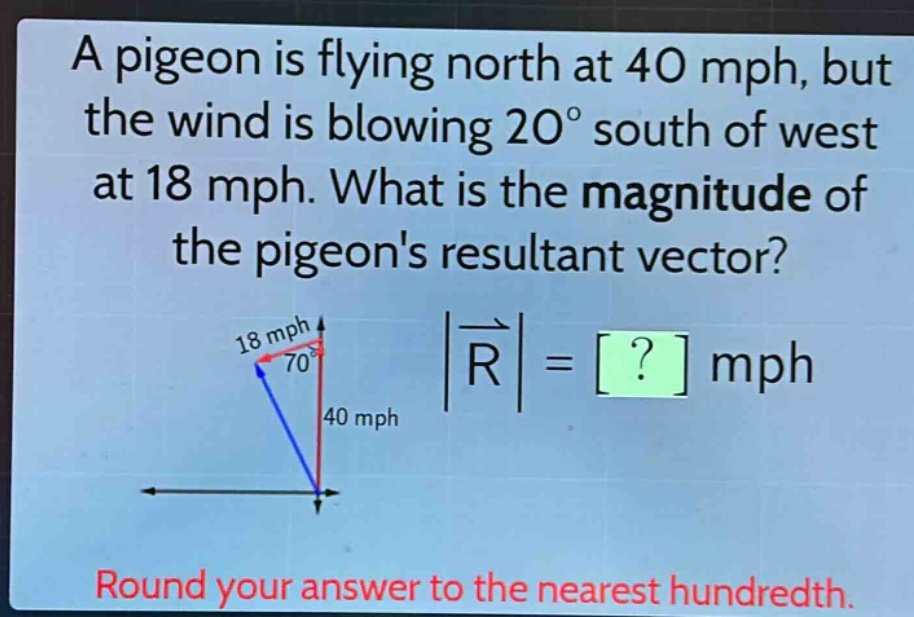
a pigeon is flying north at 40 mph, but the wind is blowing 20° south of west at 18 mph. what is the magnitude of the pigeons resultant vector? round your answer to the nearest hundredth.
Answer
Explanation:
Step1: Resolve wind - vector components
The wind has a speed of $v_w = 18$ mph at an angle $\theta=70^{\circ}$ with the negative y - axis. The x - component of the wind vector $\vec{v}{wx}=- 18\sin(70^{\circ})$ and the y - component $\vec{v}{wy}=-18\cos(70^{\circ})$. $\vec{v}{wx}=-18\sin(70^{\circ})\approx - 18\times0.9397=-16.9146$ mph. $\vec{v}{wy}=-18\cos(70^{\circ})\approx - 18\times0.3420=-6.156$ mph. The pigeon's velocity vector has $\vec{v}{px} = 0$ mph and $\vec{v}{py}=40$ mph.
Step2: Find the resultant - vector components
The x - component of the resultant vector $\vec{R}x=\vec{v}{wx}+\vec{v}{px}=-16.9146 + 0=-16.9146$ mph. The y - component of the resultant vector $\vec{R}y=\vec{v}{wy}+\vec{v}{py}=-6.156 + 40 = 33.844$ mph.
Step3: Calculate the magnitude of the resultant vector
The magnitude of a vector $\vec{R}$ with components $\vec{R}_x$ and $\vec{R}_y$ is given by $|\vec{R}|=\sqrt{\vec{R}_x^{2}+\vec{R}_y^{2}}$. $|\vec{R}|=\sqrt{(-16.9146)^{2}+(33.844)^{2}}=\sqrt{286.00 + 1145.42}=\sqrt{1431.42}\approx37.84$ mph.
Answer:
$37.84$ mph