a pigeon is flying north at 40 mph, but the wind is blowing 20° south of west at 18 mph. what is the…
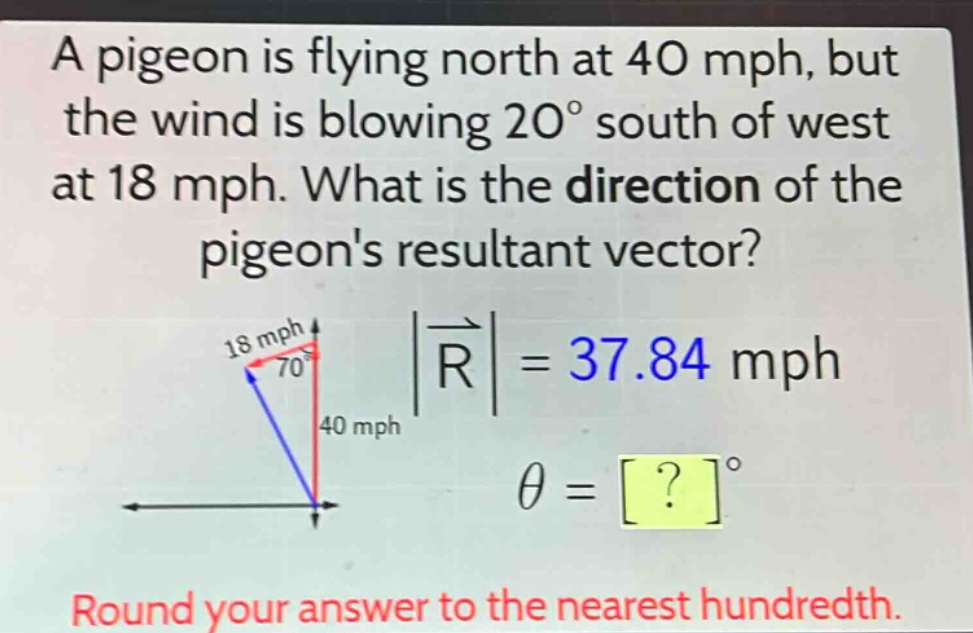
a pigeon is flying north at 40 mph, but the wind is blowing 20° south of west at 18 mph. what is the direction of the pigeons resultant vector? 18 mph 70° |r| = 37.84 mph 40 mph θ = ?° round your answer to the nearest hundredth.
Answer
Explanation:
Step1: Resolve wind - velocity components
The wind is blowing at 18 mph at an angle of 20° south - of - west. The west - east component of the wind velocity $v_{wx}=- 18\cos(20^{\circ})$ and the north - south component $v_{wy}=-18\sin(20^{\circ})$. $v_{wx}=-18\cos(20^{\circ})\approx - 16.91$ mph and $v_{wy}=-18\sin(20^{\circ})\approx - 6.16$ mph. The pigeon's velocity is $v_p = 40$ mph north.
Step2: Calculate the resultant north - south and west - east components
The resultant north - south component of the velocity $v_y=40 + v_{wy}=40-6.16 = 33.84$ mph. The resultant west - east component of the velocity $v_x=v_{wx}\approx - 16.91$ mph.
Step3: Find the direction of the resultant vector
We use the formula $\theta=\arctan\left(\frac{v_x}{v_y}\right)$. $\theta=\arctan\left(\frac{-16.91}{33.84}\right)$. $\theta\approx - 26.57^{\circ}$. The negative sign indicates the angle is measured from the north direction towards the west. So the direction is $26.57^{\circ}$ west of north.
Answer:
$26.57$