a planet has been observed orbiting a nearby star. this star has a mass of 3.5 solar masses, and the planet…
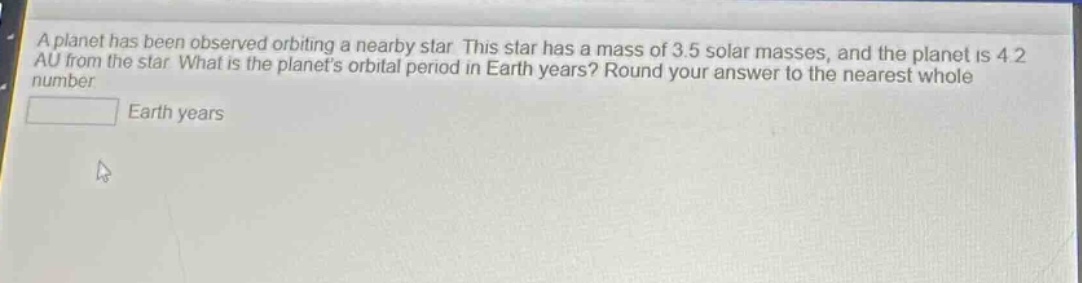
a planet has been observed orbiting a nearby star. this star has a mass of 3.5 solar masses, and the planet is 4.2 au from the star. what is the planets orbital period in earth years? round your answer to the nearest whole number. earth years
Answer
Explanation:
Step1: Recall Kepler's third - law
Kepler's third - law for a star - planet system is $T^{2}=\frac{a^{3}}{M}$, where $T$ is the orbital period in years, $a$ is the semi - major axis of the orbit in astronomical units (AU), and $M$ is the mass of the star in solar masses.
Step2: Substitute the given values
We are given that $a = 4.2$ AU and $M=3.5$ solar masses. Substitute these values into the formula: $T^{2}=\frac{(4.2)^{3}}{3.5}$. First, calculate $(4.2)^{3}=4.2\times4.2\times4.2 = 74.088$. Then, $\frac{(4.2)^{3}}{3.5}=\frac{74.088}{3.5}=21.168$.
Step3: Solve for $T$
Take the square - root of both sides: $T=\sqrt{21.168}\approx4.6$. Rounding to the nearest whole number, $T = 5$.
Answer:
5