a planet orbiting a distant star has been observed to have an orbital period of 0.76 earth years at a…
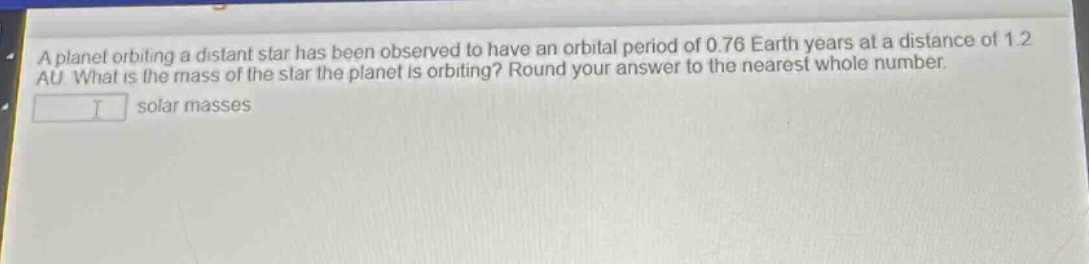
a planet orbiting a distant star has been observed to have an orbital period of 0.76 earth years at a distance of 1.2 au. what is the mass of the star the planet is orbiting? round your answer to the nearest whole number. solar masses
Answer
Explanation:
Step1: Recall Kepler's third - law
Kepler's third - law in the form for a planet orbiting a star is $T^{2}=\frac{4\pi^{2}}{GM}a^{3}$, where $T$ is the orbital period, $a$ is the semi - major axis of the orbit, $M$ is the mass of the star, and $G$ is the gravitational constant. In astronomical units (AU) and years, if we set $G = 1$ and the mass $M$ in solar masses, the formula simplifies to $T^{2}=a^{3}/M$.
Step2: Rearrange the formula for mass
We can rewrite the formula $T^{2}=a^{3}/M$ to solve for $M$. Cross - multiplying gives us $M=\frac{a^{3}}{T^{2}}$.
Step3: Substitute the given values
We are given that $T = 0.76$ years and $a = 1.2$ AU. Substitute these values into the formula: $M=\frac{(1.2)^{3}}{(0.76)^{2}}$. First, calculate $(1.2)^{3}=1.2\times1.2\times1.2 = 1.728$ and $(0.76)^{2}=0.76\times0.76 = 0.5776$. Then, $M=\frac{1.728}{0.5776}\approx3$.
Answer:
3