a point charge is used to determine the electric field around a charged particle. why is it necessary that…
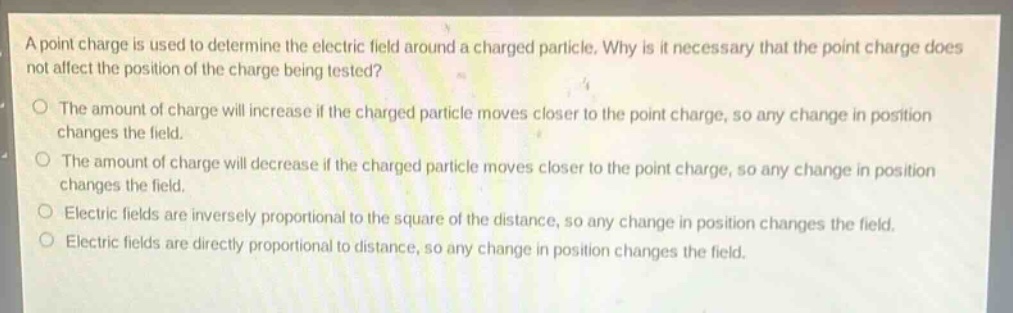
a point charge is used to determine the electric field around a charged particle. why is it necessary that the point charge does not affect the position of the charge being tested?\no the amount of charge will increase if the charged particle moves closer to the point charge, so any change in position changes the field.\no the amount of charge will decrease if the charged particle moves closer to the point charge, so any change in position changes the field.\no electric fields are inversely proportional to the square of the distance, so any change in position changes the field.\no electric fields are directly proportional to distance, so any change in position changes the field.
Answer
Brief Explanations:
The electric field $\vec{E}$ due to a point - charge $Q$ at a distance $r$ is given by $\vec{E}=\frac{kQ}{r^{2}}\hat{r}$. It is inversely proportional to the square of the distance $r$. If the position of the charge being tested changes due to the point - charge used to measure the field, the distance $r$ changes, and thus the electric field value changes. We want to measure the field of the original charged particle without disturbing its field due to the test charge's movement.
Answer:
Electric fields are inversely proportional to the square of the distance, so any change in position changes the field.