5. polonium - 20 is a radioactive element with a half - life of twenty weeks, where half - life is the…
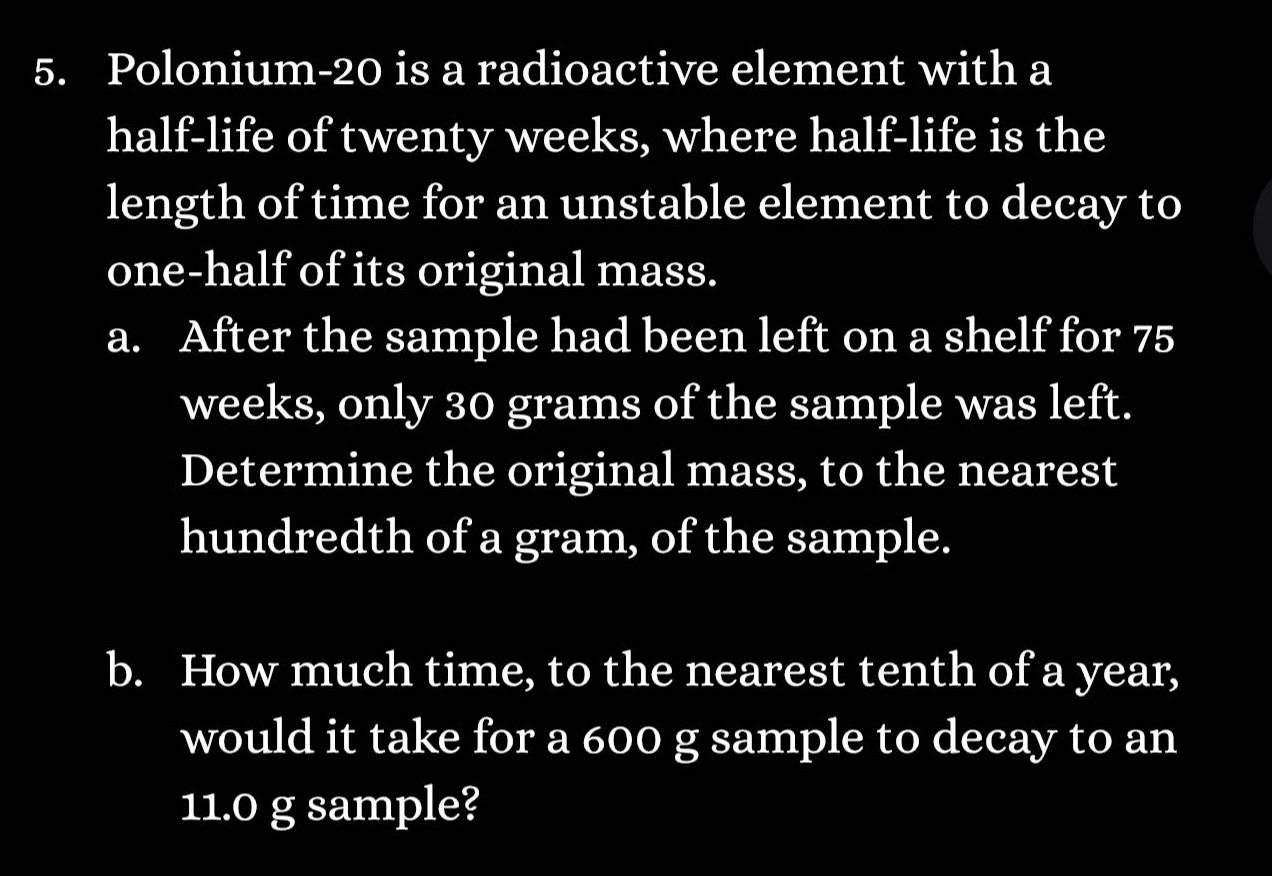
5. polonium - 20 is a radioactive element with a half - life of twenty weeks, where half - life is the length of time for an unstable element to decay to one - half of its original mass.\na. after the sample had been left on a shelf for 75 weeks, only 30 grams of the sample was left. determine the original mass, to the nearest hundredth of a gram, of the sample.\nb. how much time, to the nearest tenth of a year, would it take for a 600 g sample to decay to an 11.0 g sample?
Answer
Explanation:
Step1: Recall the radioactive - decay formula
The radioactive - decay formula is $A = A_0\left(\frac{1}{2}\right)^{\frac{t}{h}}$, where $A$ is the final amount, $A_0$ is the initial amount, $t$ is the time elapsed, and $h$ is the half - life. Given $h = 20$ weeks.
Step2: Solve part (a) for the initial amount $A_0$
We know that $A = 30$ grams, $t = 75$ weeks, and $h = 20$ weeks. Substitute these values into the formula $A = A_0\left(\frac{1}{2}\right)^{\frac{t}{h}}$: [30=A_0\left(\frac{1}{2}\right)^{\frac{75}{20}}] [30 = A_0\left(\frac{1}{2}\right)^{3.75}] [A_0=\frac{30}{\left(\frac{1}{2}\right)^{3.75}}] [A_0 = 30\times2^{3.75}] [A_0=30\times10.435756] [A_0\approx313.07] grams
Step3: Solve part (b) for the time $t$
We know that $A = 11.0$ grams, $A_0 = 600$ grams, and $h = 20$ weeks. Substitute into the formula $A = A_0\left(\frac{1}{2}\right)^{\frac{t}{h}}$: [11.0 = 600\left(\frac{1}{2}\right)^{\frac{t}{20}}] [\frac{11.0}{600}=\left(\frac{1}{2}\right)^{\frac{t}{20}}] [\log\left(\frac{11.0}{600}\right)=\log\left(\left(\frac{1}{2}\right)^{\frac{t}{20}}\right)] Using the property of logarithms $\log a^b = b\log a$, we get: [\log\left(\frac{11.0}{600}\right)=\frac{t}{20}\log\left(\frac{1}{2}\right)] [t = 20\times\frac{\log\left(\frac{11.0}{600}\right)}{\log\left(\frac{1}{2}\right)}] [t = 20\times\frac{\log11.0-\log600}{\log1 - \log2}] [t = 20\times\frac{1.041393 - 2.778151}{0 - 0.30103}] [t = 20\times\frac{- 1.736758}{- 0.30103}] [t\approx115.7] weeks Since there are 52 weeks in a year, the time in years is $\frac{115.7}{52}\approx2.2$ years
Answer:
a. $313.07$ grams b. $2.2$ years