a power source that provides a current of 1.6 a to two 5 ω resistors connected in series is moved to a…
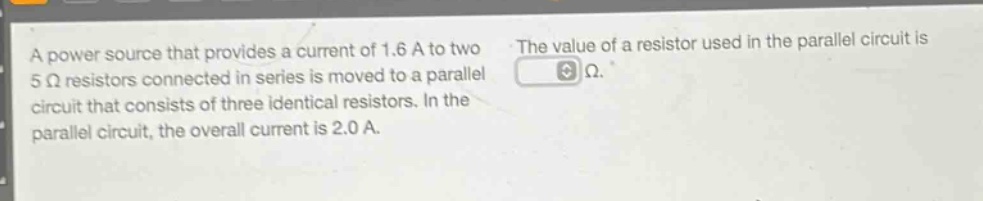
a power source that provides a current of 1.6 a to two 5 ω resistors connected in series is moved to a parallel circuit that consists of three identical resistors. in the parallel circuit, the overall current is 2.0 a. the value of a resistor used in the parallel circuit is ω.
Answer
Explanation:
Step1: Calculate voltage in series - circuit
First, find the equivalent resistance of the two - 5Ω resistors in series. The equivalent resistance $R_{s}$ of resistors in series is $R_{s}=R_1 + R_2$. Here, $R_1 = R_2=5\Omega$, so $R_{s}=5 + 5=10\Omega$. Using Ohm's law $V = IR$, with $I = 1.6A$ and $R = R_{s}=10\Omega$, we get $V=1.6\times10 = 16V$.
Step2: Calculate equivalent resistance in parallel - circuit
In the parallel circuit, the voltage $V$ remains the same (since it is the same power source), and the current $I_{p}=2.0A$. Using Ohm's law $R_{eq}=\frac{V}{I}$, with $V = 16V$ and $I = I_{p}=2.0A$, we find the equivalent resistance of the parallel circuit $R_{eq}=\frac{16}{2}=8\Omega$.
Step3: Calculate the value of each resistor in parallel - circuit
For three identical resistors $R$ in parallel, the formula for the equivalent resistance $R_{eq}$ of resistors in parallel is $\frac{1}{R_{eq}}=\frac{1}{R}+\frac{1}{R}+\frac{1}{R}=\frac{3}{R}$. We know $R_{eq}=8\Omega$, so $\frac{1}{8}=\frac{3}{R}$. Cross - multiplying gives $R = 24\Omega$.
Answer:
24