a probe is launched from earth and lands on mars. the gravitational acceleration on mars is 3.7 m/s². which…
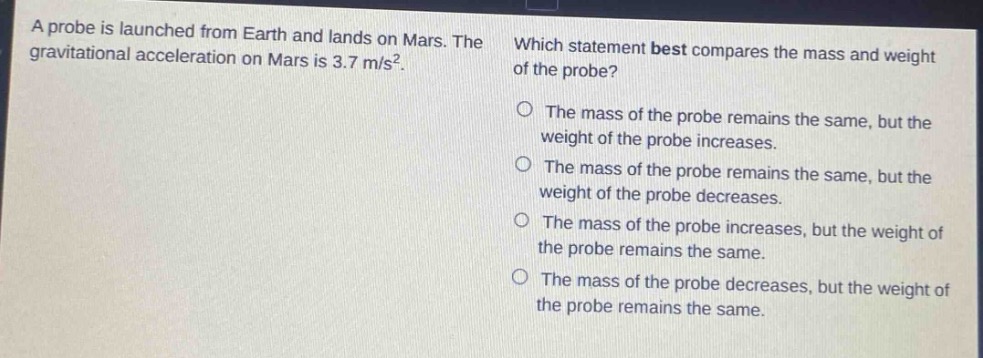
a probe is launched from earth and lands on mars. the gravitational acceleration on mars is 3.7 m/s². which statement best compares the mass and weight of the probe? o the mass of the probe remains the same, but the weight of the probe increases. o the mass of the probe remains the same, but the weight of the probe decreases. o the mass of the probe increases, but the weight of the probe remains the same. o the mass of the probe decreases, but the weight of the probe remains the same.
Answer
Brief Explanations:
Mass is a measure of the amount of matter in an object and is constant regardless of location. Weight is the force exerted on an object due to gravity, calculated as $W = mg$ (where $m$ is mass and $g$ is gravitational - acceleration). Since gravitational acceleration on Mars ($3.7\ m/s^{2}$) is less than on Earth ($\approx9.8\ m/s^{2}$), with mass remaining the same, the weight will decrease.
Answer:
The mass of the probe remains the same, but the weight of the probe decreases.