problem\nan archer stands at rest on frictionless ice; his total mass including his bow and quiver of arrows…
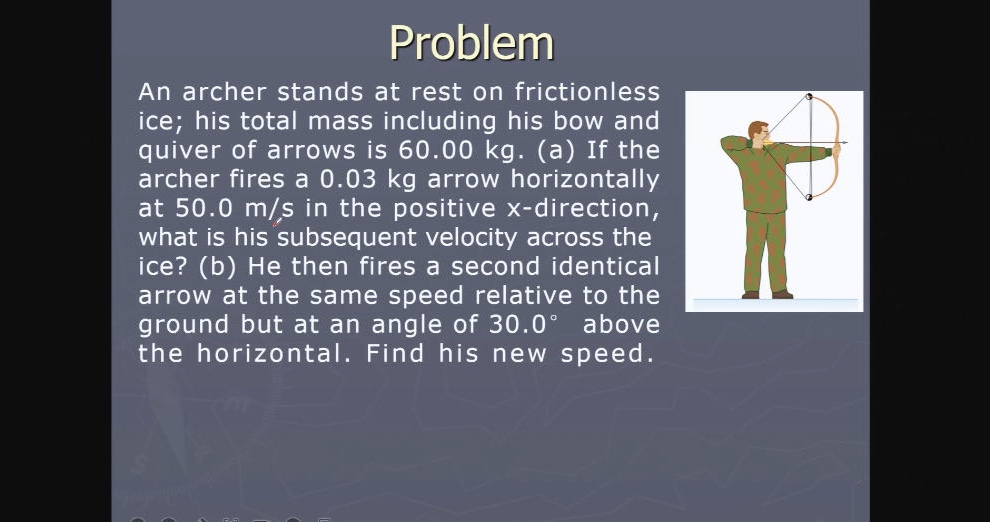
problem\nan archer stands at rest on frictionless ice; his total mass including his bow and quiver of arrows is 60.00 kg. (a) if the archer fires a 0.03 kg arrow horizontally at 50.0 m/s in the positive x - direction, what is his subsequent velocity across the ice? (b) he then fires a second identical arrow at the same speed relative to the ground but at an angle of 30.0° above the horizontal. find his new speed.
Answer
Explanation:
Step1: Apply conservation of momentum for part (a)
The initial momentum of the archer - arrow system is $P_i = 0$ (since the system is at rest). Let $m_a=0.03\ kg$ be the mass of the arrow, $v_a = 50.0\ m/s$ be the velocity of the arrow, and $M = 60.00\ kg$ be the mass of the archer. According to the law of conservation of momentum $P_i=P_f$, so $0=m_a v_a+Mv$. Solving for $v$ (the velocity of the archer), we get $v=-\frac{m_a v_a}{M}$.
Step2: Calculate the velocity of the archer in part (a)
Substitute $m_a = 0.03\ kg$, $v_a = 50.0\ m/s$ and $M = 60.00\ kg$ into the formula $v=-\frac{m_a v_a}{M}$. Then $v=-\frac{0.03\times50}{60}=- 0.025\ m/s$. The negative sign indicates the direction is in the negative x - direction.
Step3: Apply conservation of momentum for part (b) in the x - direction
The initial momentum of the archer - arrow system in the x - direction after the first shot is $P_{ix}=-M_1v_1$, where $M_1 = 60 - 0.03=59.97\ kg$ and $v_1 = 0.025\ m/s$. The momentum of the second arrow in the x - direction is $m_a v_a\cos30^{\circ}$. Let $v_2$ be the new velocity of the archer. By conservation of momentum in the x - direction $-M_1v_1=m_a v_a\cos30^{\circ}+(M_1 - m_a)v_2$.
Step4: Solve for the new velocity of the archer in part (b)
First, substitute the values: $M_1 = 59.97\ kg$, $v_1 = 0.025\ m/s$, $m_a = 0.03\ kg$, $v_a = 50.0\ m/s$. [ \begin{align*} -59.97\times0.025&=0.03\times50\times\cos30^{\circ}+(59.97 - 0.03)v_2\
- 1.49925&=0.03\times50\times\frac{\sqrt{3}}{2}+59.94v_2\ -1.49925&=1.299 + 59.94v_2\ 59.94v_2&=-1.49925 - 1.299\ 59.94v_2&=-2.79825\ v_2&=-\frac{2.79825}{59.94}\approx - 0.0467\ m/s \end{align*} ]
Answer:
(a) $-0.025\ m/s$ (b) $-0.0467\ m/s$