problem 1.1 - determine the magnitude and direction of the resultant of the forces shown using the triangle…
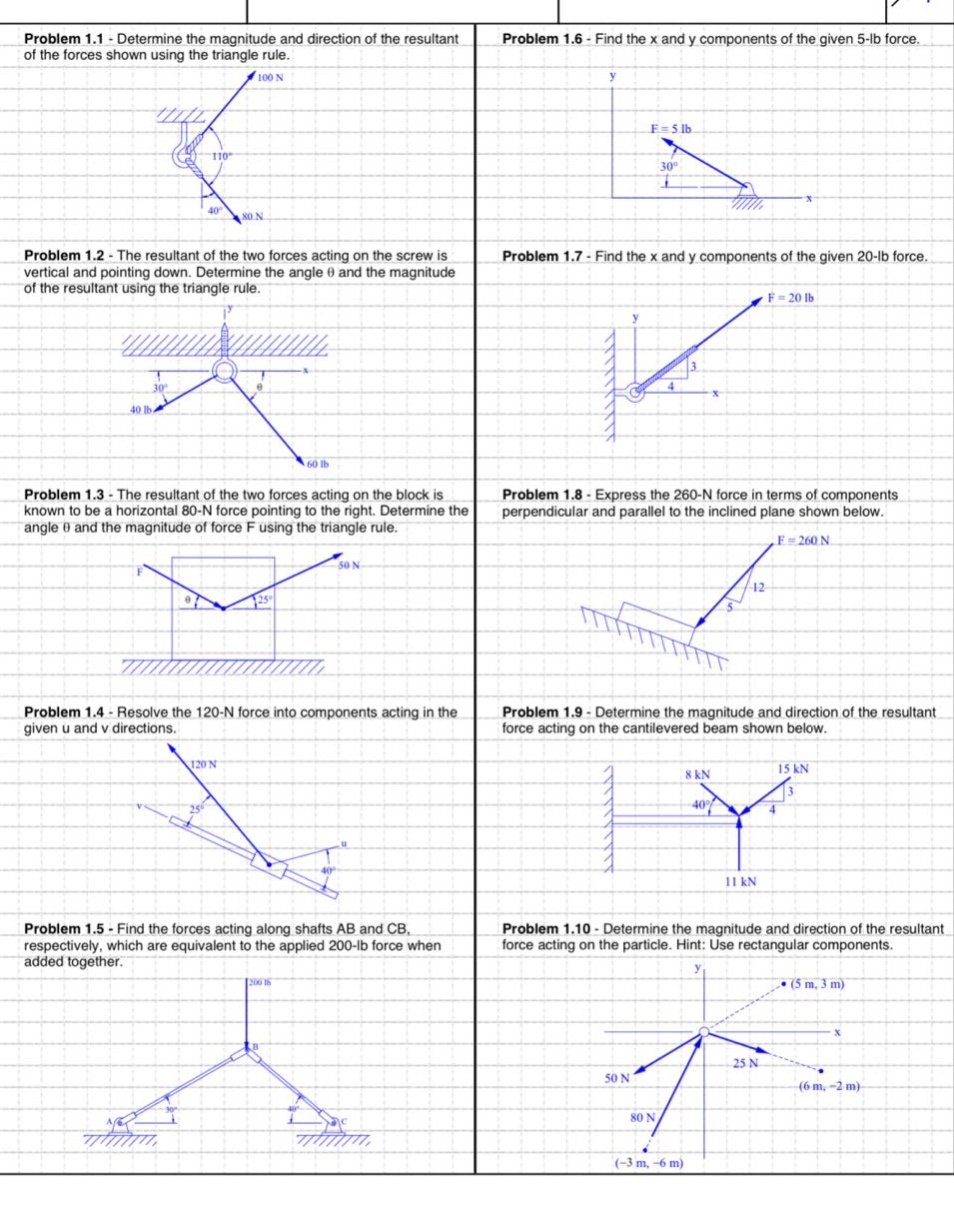
problem 1.1 - determine the magnitude and direction of the resultant of the forces shown using the triangle rule.\nproblem 1.2 - the resultant of the two forces acting on the screw is vertical and pointing down. determine the angle θ and the magnitude of the resultant using the triangle rule.\nproblem 1.3 - the resultant of the two forces acting on the block is known to be a horizontal 80 - n force pointing to the right. determine the angle θ and the magnitude of force f using the triangle rule.\nproblem 1.4 - resolve the 120 - n force into components acting in the given u and v directions.\nproblem 1.5 - find the forces acting along shafts ab and cb, respectively, which are equivalent to the applied 200 - lb force when added together.\nproblem 1.6 - find the x and y components of the given 5 - lb force.\nproblem 1.7 - find the x and y components of the given 20 - lb force.\nproblem 1.8 - express the 260 - n force in terms of components perpendicular and parallel to the inclined plane shown below.\nproblem 1.9 - determine the magnitude and direction of the resultant force acting on the cantilevered beam shown below.\nproblem 1.10 - determine the magnitude and direction of the resultant force acting on the particle. hint: use rectangular components.
Answer
Explanation:
Step1: Identify the problem - type
These are problems related to force - vector analysis.
Step2: For force - component problems
Use trigonometric relations. For example, for a force $F$ at an angle $\theta$ with the $x$ - axis, the $x$ - component $F_x = F\cos\theta$ and the $y$ - component $F_y = F\sin\theta$.
Step3: For resultant - force problems using the triangle rule
Apply the law of cosines and law of sines. If two forces $\vec{F}_1$ and $\vec{F}_2$ with an included angle $\alpha$ are given, the magnitude of the resultant force $R$ is $R=\sqrt{F_1^{2}+F_2^{2}-2F_1F_2\cos(180^{\circ}-\alpha)}$ and the direction can be found using the law of sines $\frac{\sin\beta}{F_1}=\frac{\sin(180^{\circ}-\alpha)}{R}$, where $\beta$ is the angle between $R$ and $F_2$.
Let's solve Problem 1.6 as an example: Given a force $F = 5$ lb at an angle $\theta=30^{\circ}$ with the $x$ - axis.
Step4: Calculate the $x$ - component
$F_x=F\cos\theta=5\cos30^{\circ}=5\times\frac{\sqrt{3}}{2}\approx4.33$ lb.
Step5: Calculate the $y$ - component
$F_y = F\sin\theta=5\sin30^{\circ}=5\times\frac{1}{2}=2.5$ lb.
Answer:
For Problem 1.6: $F_x\approx4.33$ lb, $F_y = 2.5$ lb. (Note: This is just an example solution for one problem. The same approach can be applied to other problems in the set.)