problem 1.1 - determine the magnitude and direction of the resultant of the forces shown using the triangle…
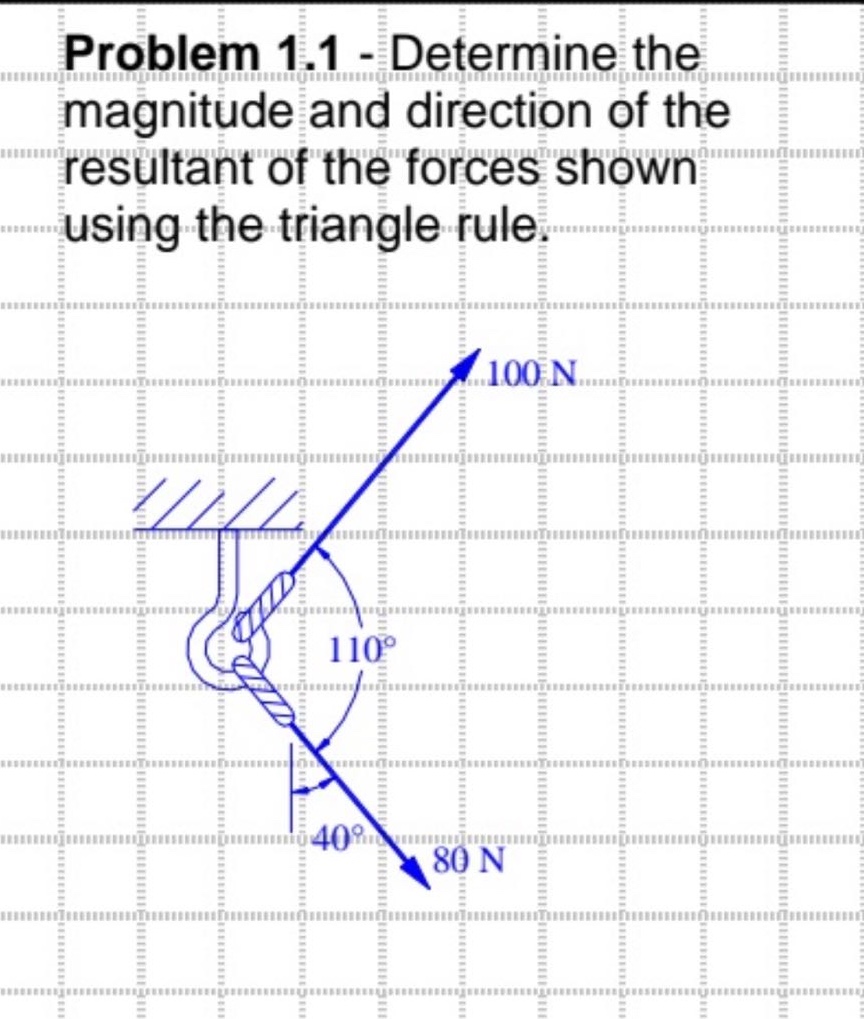
problem 1.1 - determine the magnitude and direction of the resultant of the forces shown using the triangle rule.
Answer
Explanation:
Step1: Resolve forces into components
Let the $100 - N$ force be $\vec{F}1$ and the $80 - N$ force be $\vec{F}2$. For $\vec{F}1 = 100\ N$ at an angle $\theta_1= 110^{\circ}$ with the horizontal: $F{1x}=100\cos(110^{\circ})\ N$ and $F{1y}=100\sin(110^{\circ})\ N$. $F{1x}=100\times(- 0.342)\ N=-34.2\ N$, $F_{1y}=100\times0.940\ N = 94.0\ N$. For $\vec{F}2 = 80\ N$ at an angle $\theta_2 = 220^{\circ}$ with the horizontal: $F{2x}=80\cos(220^{\circ})\ N$ and $F_{2y}=80\sin(220^{\circ})\ N$. $F_{2x}=80\times(-0.766)\ N=-61.28\ N$, $F_{2y}=80\times(-0.643)\ N=-51.44\ N$.
Step2: Sum the x - components and y - components
$R_x=F_{1x}+F_{2x}=-34.2 - 61.28=-95.48\ N$. $R_y=F_{1y}+F_{2y}=94.0-51.44 = 42.56\ N$.
Step3: Calculate the magnitude of the resultant force
$R=\sqrt{R_x^{2}+R_y^{2}}=\sqrt{(-95.48)^{2}+42.56^{2}}=\sqrt{9116.43+1811.35}=\sqrt{10927.78}\approx104.5\ N$.
Step4: Calculate the direction of the resultant force
$\theta=\tan^{- 1}\left(\frac{R_y}{R_x}\right)=\tan^{-1}\left(\frac{42.56}{-95.48}\right)$. Since $R_x<0$ and $R_y>0$, the angle is in the second - quadrant. $\theta = 180^{\circ}+\tan^{-1}\left(\frac{42.56}{-95.48}\right)\approx180^{\circ}-23.9^{\circ}=156.1^{\circ}$ with the positive x - axis.
Answer:
Magnitude: approximately $104.5\ N$, Direction: approximately $156.1^{\circ}$ with the positive x - axis.