problem. force t is applied at point c on the semi - circle shown below. determine the moment due to force t…
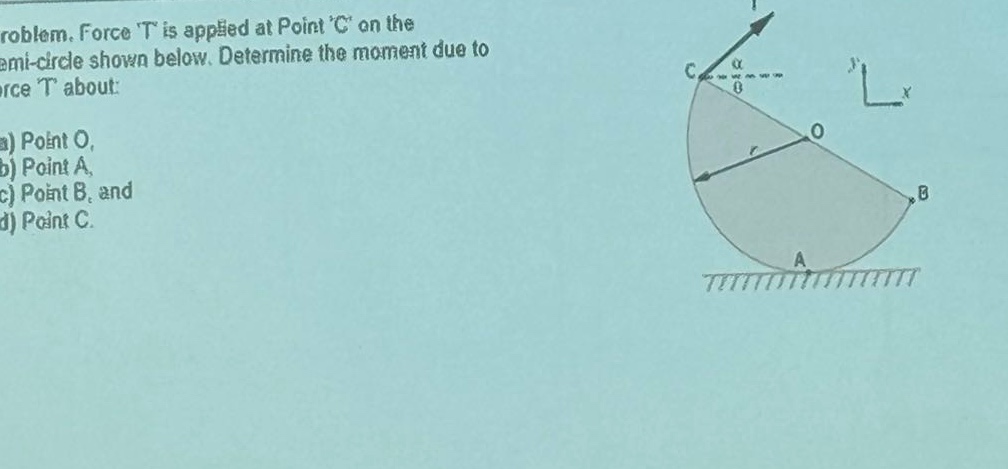
problem. force t is applied at point c on the semi - circle shown below. determine the moment due to force t about:\na) point o,\nb) point a,\nc) point b, and\nd) point c.
Answer
Explanation:
Step1: Recall moment formula
The moment of a force $\vec{F}$ about a point $P$ is given by $\vec{M}=\vec{r}\times\vec{F}$, where $\vec{r}$ is the position - vector from point $P$ to the point of application of the force. In scalar form, $M = rF\sin\theta$, where $r$ is the magnitude of the position - vector, $F$ is the magnitude of the force, and $\theta$ is the angle between $\vec{r}$ and $\vec{F}$.
Step2: Find moment about point O
The position vector $\vec{r}_{OC}=r\hat{i}$ (assuming the center of the semi - circle is at the origin $O$). The force $\vec{T}$ can be resolved into its components: $\vec{T}=T\cos\alpha\hat{i}+T\sin\alpha\hat{j}$. Using the cross - product formula $\vec{M}O=\vec{r}{OC}\times\vec{T}$, we have $\vec{M}_O=\begin{vmatrix}\hat{i}&\hat{j}&\hat{k}\r&0&0\T\cos\alpha&T\sin\alpha&0\end{vmatrix}=rT\sin\alpha\hat{k}$. So, $M_O = rT\sin\alpha$.
Step3: Find moment about point A
The position vector $\vec{r}_{AC}=(r + r\cos\theta)\hat{i}+r\sin\theta\hat{j}$ (where $\theta$ is the angle of point $C$ measured from the negative $x$ - axis). $\vec{T}=T\cos\alpha\hat{i}+T\sin\alpha\hat{j}$. $\vec{M}A=\vec{r}{AC}\times\vec{T}=\begin{vmatrix}\hat{i}&\hat{j}&\hat{k}\r(1 + \cos\theta)&r\sin\theta&0\T\cos\alpha&T\sin\alpha&0\end{vmatrix}=rT(\sin\alpha+\sin\alpha\cos\theta-\sin\theta\cos\alpha)\hat{k}$.
Step4: Find moment about point B
The position vector $\vec{r}_{BC}=( - r)\hat{i}+r\sin\theta\hat{j}$. $\vec{T}=T\cos\alpha\hat{i}+T\sin\alpha\hat{j}$. $\vec{M}B=\vec{r}{BC}\times\vec{T}=\begin{vmatrix}\hat{i}&\hat{j}&\hat{k}\-r&r\sin\theta&0\T\cos\alpha&T\sin\alpha&0\end{vmatrix}=rT(-\sin\alpha-\sin\theta\cos\alpha)\hat{k}$.
Step5: Find moment about point C
The position vector $\vec{r}_{CC}=\vec{0}$. Using the moment formula $\vec{M}=\vec{r}\times\vec{F}$, we get $\vec{M}_C=\vec{0}\times\vec{T}=\vec{0}$. So, $M_C = 0$.
Answer:
a) $M_O = rT\sin\alpha$ b) $M_A=rT(\sin\alpha+\sin\alpha\cos\theta - \sin\theta\cos\alpha)$ c) $M_B=rT(-\sin\alpha-\sin\theta\cos\alpha)$ d) $M_C = 0$