problem 3: as shown in the figure, a load p is supported by the tripod. if the force in any leg is limited…
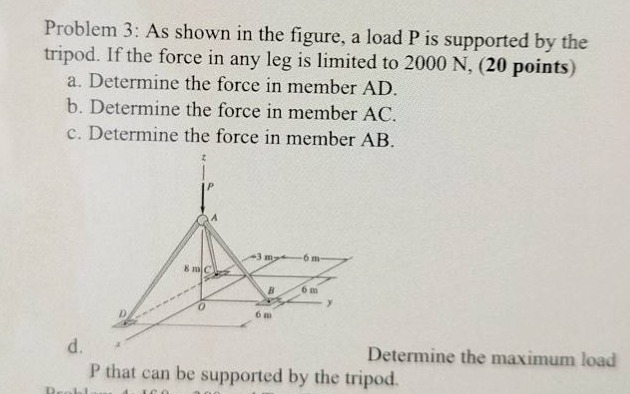
problem 3: as shown in the figure, a load p is supported by the tripod. if the force in any leg is limited to 2000 n, (20 points)\na. determine the force in member ad.\nb. determine the force in member ac.\nc. determine the force in member ab.\nd. determine the maximum load p that can be supported by the tripod.
Answer
Explanation:
Step1: Establish coordinate system
Let the origin be at $O$. The position vectors of points $A(0,0,8)$, $B(6,6,0)$, $C( - 3,6,0)$, $D(-6,0,0)$.
Step2: Find unit - vectors of the members
The vector $\overrightarrow{AD}=\langle-6 - 0,0 - 0,0 - 8\rangle=\langle-6,0,-8\rangle$, and the unit - vector $\hat{u}{AD}=\frac{\overrightarrow{AD}}{\vert\overrightarrow{AD}\vert}=\frac{\langle-6,0,-8\rangle}{\sqrt{(-6)^2+0^2+(-8)^2}}=\langle-\frac{3}{5},0,-\frac{4}{5}\rangle$. The vector $\overrightarrow{AC}=\langle-3 - 0,6 - 0,0 - 8\rangle=\langle-3,6,-8\rangle$, and the unit - vector $\hat{u}{AC}=\frac{\overrightarrow{AC}}{\vert\overrightarrow{AC}\vert}=\frac{\langle-3,6,-8\rangle}{\sqrt{(-3)^2 + 6^2+(-8)^2}}=\langle-\frac{3}{\sqrt{73}},\frac{6}{\sqrt{73}},-\frac{8}{\sqrt{73}}\rangle$. The vector $\overrightarrow{AB}=\langle6 - 0,6 - 0,0 - 8\rangle=\langle6,6,-8\rangle$, and the unit - vector $\hat{u}_{AB}=\frac{\overrightarrow{AB}}{\vert\overrightarrow{AB}\vert}=\frac{\langle6,6,-8\rangle}{\sqrt{6^2+6^2+(-8)^2}}=\langle\frac{3}{5},\frac{3}{5},-\frac{4}{5}\rangle$.
Step3: Set up equilibrium equations
At point $A$, $\sum\vec{F}=\vec{0}$, so $\vec{F}{AD}\hat{u}{AD}+\vec{F}{AC}\hat{u}{AC}+\vec{F}{AB}\hat{u}{AB}-P\hat{k}=\vec{0}$. In the $x$ - direction: $F_{AD}(-\frac{3}{5})+F_{AC}(-\frac{3}{\sqrt{73}})+F_{AB}(\frac{3}{5}) = 0$. In the $y$ - direction: $F_{AC}(\frac{6}{\sqrt{73}})+F_{AB}(\frac{3}{5}) = 0$. In the $z$ - direction: $F_{AD}(-\frac{4}{5})+F_{AC}(-\frac{8}{\sqrt{73}})+F_{AB}(-\frac{4}{5})-P = 0$. Assume the forces in the members are in tension. From the $y$ - direction equation $F_{AC}=-\frac{\sqrt{73}}{10}F_{AB}$. Substitute $F_{AC}$ into the $x$ - direction equation: [ \begin{align*} F_{AD}(-\frac{3}{5})-\frac{\sqrt{73}}{10}F_{AB}(-\frac{3}{\sqrt{73}})+F_{AB}(\frac{3}{5})&=0\ -\frac{3}{5}F_{AD}+\frac{3}{10}F_{AB}+\frac{3}{5}F_{AB}&=0\ -\frac{3}{5}F_{AD}+\frac{9}{10}F_{AB}&=0\ F_{AD}=\frac{3}{2}F_{AB} \end{align*} ] Substitute $F_{AD}$ and $F_{AC}$ into the $z$ - direction equation: [ \begin{align*} \frac{3}{2}F_{AB}(-\frac{4}{5})-\frac{\sqrt{73}}{10}F_{AB}(-\frac{8}{\sqrt{73}})+F_{AB}(-\frac{4}{5})-P&=0\ -\frac{6}{5}F_{AB}+\frac{4}{5}F_{AB}-\frac{4}{5}F_{AB}-P&=0\ -\frac{6}{5}F_{AB}-P&=0\ F_{AB}=-\frac{5}{6}P \end{align*} ] Then $F_{AD}=-\frac{5}{4}P$ and $F_{AC}=\frac{\sqrt{73}}{12}P$. a. Since the force in any leg is limited to $2000$ N. Let's first find $F_{AD}$. We know $F_{AD}=-\frac{5}{4}P$. b. $F_{AC}=\frac{\sqrt{73}}{12}P$. c. $F_{AB}=-\frac{5}{6}P$. d. Since $\vert F_{AD}\vert\leq2000$, $\vert F_{AC}\vert\leq2000$, $\vert F_{AB}\vert\leq2000$. For $F_{AD}$, $\vert-\frac{5}{4}P\vert = 2000$, then $P = 1600$ N. For $F_{AC}$, $\vert\frac{\sqrt{73}}{12}P\vert=2000$, $P=\frac{24000}{\sqrt{73}}\approx2790$ N. For $F_{AB}$, $\vert-\frac{5}{6}P\vert = 2000$, $P = 2400$ N. The maximum load $P$ is determined by the member with the smallest allowable - load capacity. So the maximum load $P = 1600$ N.
a. $F_{AD}=-\frac{5}{4}P$ (in terms of $P$), when considering the limit, if we assume the maximum - force condition for $AD$ and $P = 1600$ N, then $F_{AD}=- 2000$ N. b. $F_{AC}=\frac{\sqrt{73}}{12}P$, when $P = 1600$ N, $F_{AC}=\frac{\sqrt{73}}{12}\times1600\approx1493$ N. c. $F_{AB}=-\frac{5}{6}P$, when $P = 1600$ N, $F_{AB}=-\frac{5}{6}\times1600\approx - 1333$ N. d. # Answer: $1600$ N