problem: you push a heavy crate down a ramp at a constant velocity. only four forces act on the crate. which…
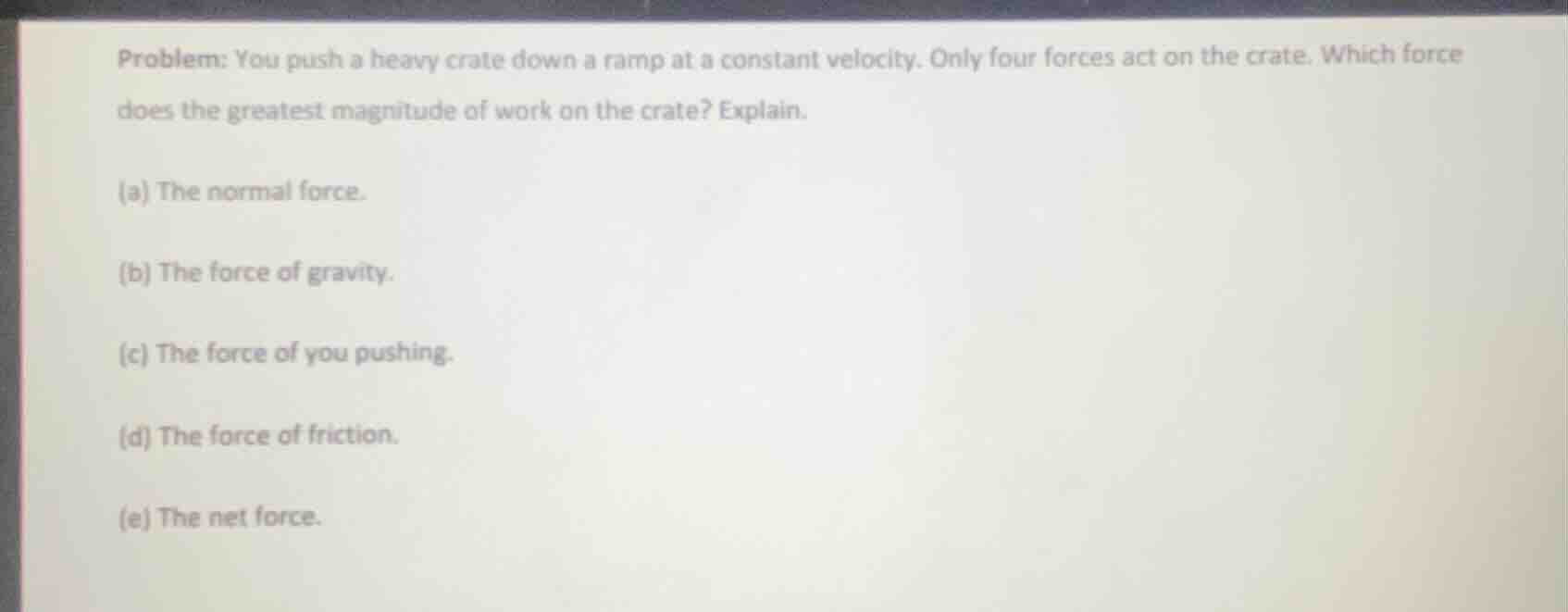
problem: you push a heavy crate down a ramp at a constant velocity. only four forces act on the crate. which force does the greatest magnitude of work on the crate? explain.\n\n(a) the normal force.\n(b) the force of gravity.\n(c) the force of you pushing.\n(d) the force of friction.\n(e) the net force.
Answer
Explanation:
Step1: Identify forces acting on the crate
The four forces are gravity ($F_g$), normal force ($F_n$), push force ($F_p$), and friction ($F_f$).
Step2: Determine work done by each force
Normal force is perpendicular to displacement, so $W_n = 0$. Gravity and push force do positive work ($W_g, W_p > 0$). Friction opposes motion, doing negative work ($W_f < 0$).
Step3: Apply the Work-Energy Theorem
Constant velocity means $\Delta K = 0$. Thus, net work is zero: $W_{net} = W_g + W_p + W_f = 0$.
Step4: Compare magnitudes of work
Since $W_g + W_p + W_f = 0$, it follows that $|W_f| = |W_g + W_p|$. Therefore, the magnitude of work done by friction must be greater than the magnitude of work done by gravity or the push force individually.
Answer:
(d) The force of friction.