the projectile motion of an object can be modeled using $h(t)=\frac{1}{2}gt^{2}+v_{0}t + h_{0}$, where $g$…
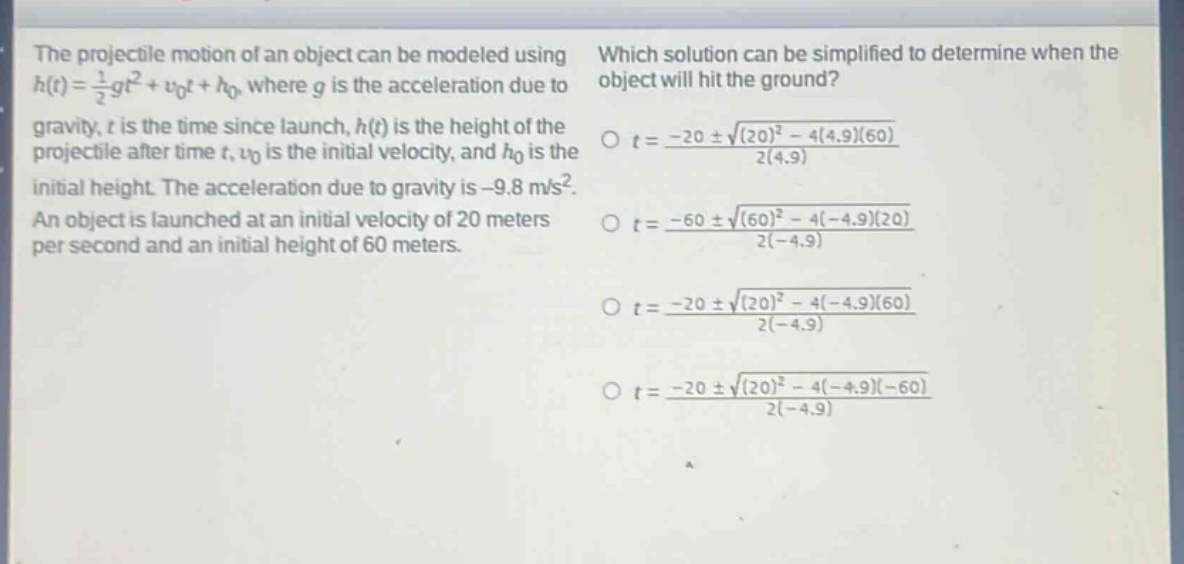
the projectile motion of an object can be modeled using $h(t)=\frac{1}{2}gt^{2}+v_{0}t + h_{0}$, where $g$ is the acceleration due to gravity, $t$ is the time since launch, $h(t)$ is the height of the projectile after time $t$, $v_{0}$ is the initial velocity, and $h_{0}$ is the initial height. the acceleration due to gravity is $- 9.8 m/s^{2}$. an object is launched at an initial velocity of 20 meters per second and an initial height of 60 meters. which solution can be simplified to determine when the object will hit the ground? $t=\frac{-20pmsqrt{(20)^{2}-4(4.9)(60)}}{2(4.9)}$ $t=\frac{-60pmsqrt{(60)^{2}-4(-4.9)(20)}}{2(-4.9)}$ $t=\frac{-20pmsqrt{(20)^{2}-4(-4.9)(60)}}{2(-4.9)}$ $t=\frac{-20pmsqrt{(20)^{2}-4(-4.9)(-60)}}{2(-4.9)}$
Answer
Explanation:
Step1: Set height to 0
When the object hits the ground, $h(t)=0$. The equation $h(t)=\frac{1}{2}gt^{2}+v_{0}t + h_{0}$ becomes $0=\frac{1}{2}gt^{2}+v_{0}t + h_{0}$. Given $g=- 9.8\ m/s^{2}$, $v_{0}=20\ m/s$, and $h_{0}=60\ m$, the equation is $0=\frac{1}{2}(-9.8)t^{2}+20t + 60$, or $-4.9t^{2}+20t + 60 = 0$.
Step2: Recall quadratic - formula
The quadratic formula for $ax^{2}+bx + c = 0$ is $t=\frac{-b\pm\sqrt{b^{2}-4ac}}{2a}$. For $-4.9t^{2}+20t + 60 = 0$, $a=-4.9$, $b = 20$, and $c = 60$.
Step3: Substitute values into quadratic - formula
Substitute $a=-4.9$, $b = 20$, and $c = 60$ into the quadratic formula: $t=\frac{-20\pm\sqrt{(20)^{2}-4(-4.9)(60)}}{2(-4.9)}$.
Answer:
$t=\frac{-20\pm\sqrt{(20)^{2}-4(-4.9)(60)}}{2(-4.9)}$