the projectile motion of an object can be modeled using s(t)=gt² + v₀t + s₀, where g is the acceleration due…
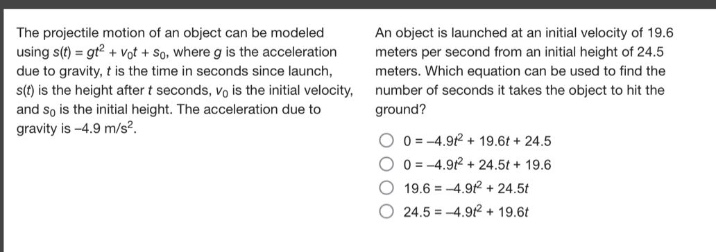
the projectile motion of an object can be modeled using s(t)=gt² + v₀t + s₀, where g is the acceleration due to gravity, t is the time in seconds since launch, s(t) is the height after t seconds, v₀ is the initial velocity, and s₀ is the initial height. the acceleration due to gravity is -4.9 m/s². an object is launched at an initial velocity of 19.6 meters per second from an initial height of 24.5 meters. which equation can be used to find the number of seconds it takes the object to hit the ground? 0 = -4.9t² + 19.6t + 24.5 0 = -4.9t² + 24.5t + 19.6 19.6 = -4.9t² + 24.5t 24.5 = -4.9t² + 19.6t
Answer
Answer:
$0=-4.9t^{2}+19.6t + 24.5$
Explanation:
Step1: Identify the hitting - ground condition
When the object hits the ground, $s(t)=0$.
Step2: Substitute given values into the formula
Given $g=-4.9\ m/s^{2}$, $v_0 = 19.6\ m/s$, $s_0=24.5\ m$ into $s(t)=gt^{2}+v_0t + s_0$. We get $0=-4.9t^{2}+19.6t + 24.5$.