the projectile motion of an object can be modeled using s(t)=gt² + v₀t + s₀, where g is the acceleration due…
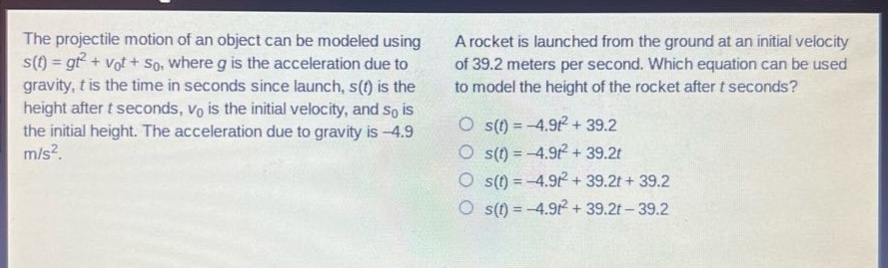
the projectile motion of an object can be modeled using s(t)=gt² + v₀t + s₀, where g is the acceleration due to gravity, t is the time in seconds since launch, s(t) is the height after t seconds, v₀ is the initial velocity, and s₀ is the initial height. the acceleration due to gravity is -4.9 m/s². a rocket is launched from the ground at an initial velocity of 39.2 meters per second. which equation can be used to model the height of the rocket after t seconds? s(t)= -4.9t² + 39.2 s(t)= -4.9t² + 39.2t s(t)= -4.9t² + 39.2t + 39.2 s(t)= -4.9t² + 39.2t - 39.2
Answer
Explanation:
Step1: Identify the values of variables
The acceleration due to gravity $g=- 4.9\ m/s^{2}$, the initial velocity $v_0 = 39.2\ m/s$, and since the rocket is launched from the ground, the initial height $s_0 = 0$.
Step2: Substitute values into the formula
The formula for projectile - motion is $s(t)=gt^{2}+v_0t + s_0$. Substituting $g=-4.9$, $v_0 = 39.2$, and $s_0 = 0$ into the formula, we get $s(t)=-4.9t^{2}+39.2t+0=-4.9t^{2}+39.2t$.
Answer:
$s(t)=-4.9t^{2}+39.2t$ (corresponding to the second option in the multiple - choice list)