a proton is moved so that its electric potential energy increases from 4.0×10⁻¹⁴ j to 9.0×10⁻¹⁴ j. the…
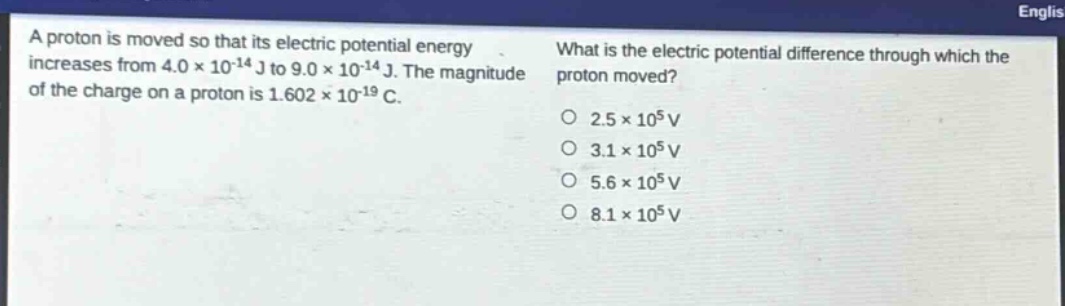
a proton is moved so that its electric potential energy increases from 4.0×10⁻¹⁴ j to 9.0×10⁻¹⁴ j. the magnitude of the charge on a proton is 1.602×10⁻¹⁹ c. what is the electric potential difference through which the proton moved? 2.5×10⁵ v 3.1×10⁵ v 5.6×10⁵ v 8.1×10⁵ v
Answer
Explanation:
Step1: Calculate change in electric - potential energy
The change in electric - potential energy $\Delta U$ is given by $\Delta U=U_f - U_i$. Here, $U_i = 4.0\times10^{-14}\text{ J}$ and $U_f=9.0\times10^{-14}\text{ J}$. So, $\Delta U=(9.0\times 10^{-14}-4.0\times 10^{-14})\text{ J}=5.0\times 10^{-14}\text{ J}$.
Step2: Use the formula for electric - potential difference
The formula for electric - potential difference $\Delta V$ is $\Delta V=\frac{\Delta U}{q}$, where $q$ is the charge. Given $q = 1.602\times10^{-19}\text{ C}$ and $\Delta U = 5.0\times 10^{-14}\text{ J}$. Then $\Delta V=\frac{5.0\times 10^{-14}\text{ J}}{1.602\times10^{-19}\text{ C}}\approx3.1\times 10^{5}\text{ V}$.
Answer:
$3.1\times 10^{5}\text{ V}$