a proton is at the origin. one electron is at the point 2 meters to the left of the origin, and the other is…
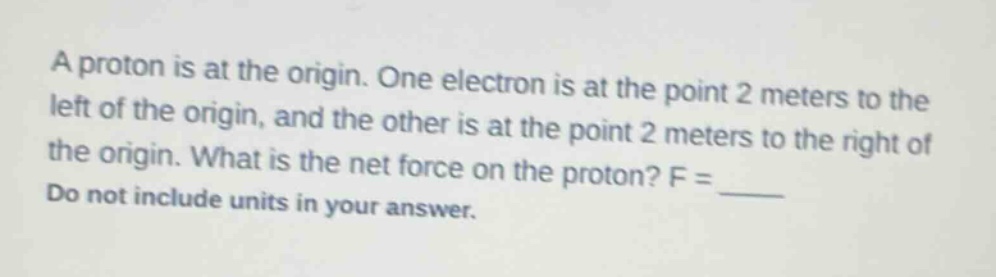
a proton is at the origin. one electron is at the point 2 meters to the left of the origin, and the other is at the point 2 meters to the right of the origin. what is the net force on the proton? f = ____ do not include units in your answer.
Answer
Explanation:
Step1: Identify the Coulomb's law formula
The force between two charged - particles is given by $F = k\frac{q_1q_2}{r^2}$, where $k = 9\times10^{9}\ N\cdot m^{2}/C^{2}$, $q_1$ and $q_2$ are the charges of the two particles, and $r$ is the distance between them. The charge of a proton is $q_p= 1.6\times10^{-19}\ C$ and the charge of an electron is $q_e=- 1.6\times10^{-19}\ C$.
Step2: Calculate the force due to the left - hand electron
Let the left - hand electron be at $r_1=-2\ m$ from the proton at the origin. Using Coulomb's law, $F_1 = k\frac{q_pq_e}{r_1^{2}}$. Substituting the values: $q_p = 1.6\times10^{-19}\ C$, $q_e=-1.6\times10^{-19}\ C$, $r_1 = 2\ m$, and $k = 9\times10^{9}\ N\cdot m^{2}/C^{2}$, we get $F_1=9\times10^{9}\times\frac{(1.6\times10^{-19})\times(-1.6\times10^{-19})}{2^{2}}$.
Step3: Calculate the force due to the right - hand electron
Let the right - hand electron be at $r_2 = 2\ m$ from the proton at the origin. Using Coulomb's law, $F_2 = k\frac{q_pq_e}{r_2^{2}}$. Substituting the values: $q_p = 1.6\times10^{-19}\ C$, $q_e=-1.6\times10^{-19}\ C$, $r_2 = 2\ m$, and $k = 9\times10^{9}\ N\cdot m^{2}/C^{2}$, we get $F_2=9\times10^{9}\times\frac{(1.6\times10^{-19})\times(-1.6\times10^{-19})}{2^{2}}$.
Step4: Calculate the net force
The forces $F_1$ and $F_2$ are both attractive forces (since the proton and electron have opposite charges). The direction of $F_1$ is to the left and the direction of $F_2$ is to the right. The magnitudes of $F_1$ and $F_2$ are equal. So, the net force $F_{net}=F_1 + F_2$. [ \begin{align*} F_1&=F_2=9\times10^{9}\times\frac{(1.6\times10^{-19})\times(1.6\times10^{-19})}{4}\ &=9\times10^{9}\times\frac{2.56\times10^{-38}}{4}\ &=5.76\times10^{-29}\ N \end{align*} ] $F_{net}=F_1 + F_2=2\times5.76\times10^{-29}=1.152\times10^{-28}$
Answer:
$1.152\times10^{-28}$