the quantity of a radioactive substance decays according to the function $q(t)=100e^{-\frac{t}{4}}$, where…
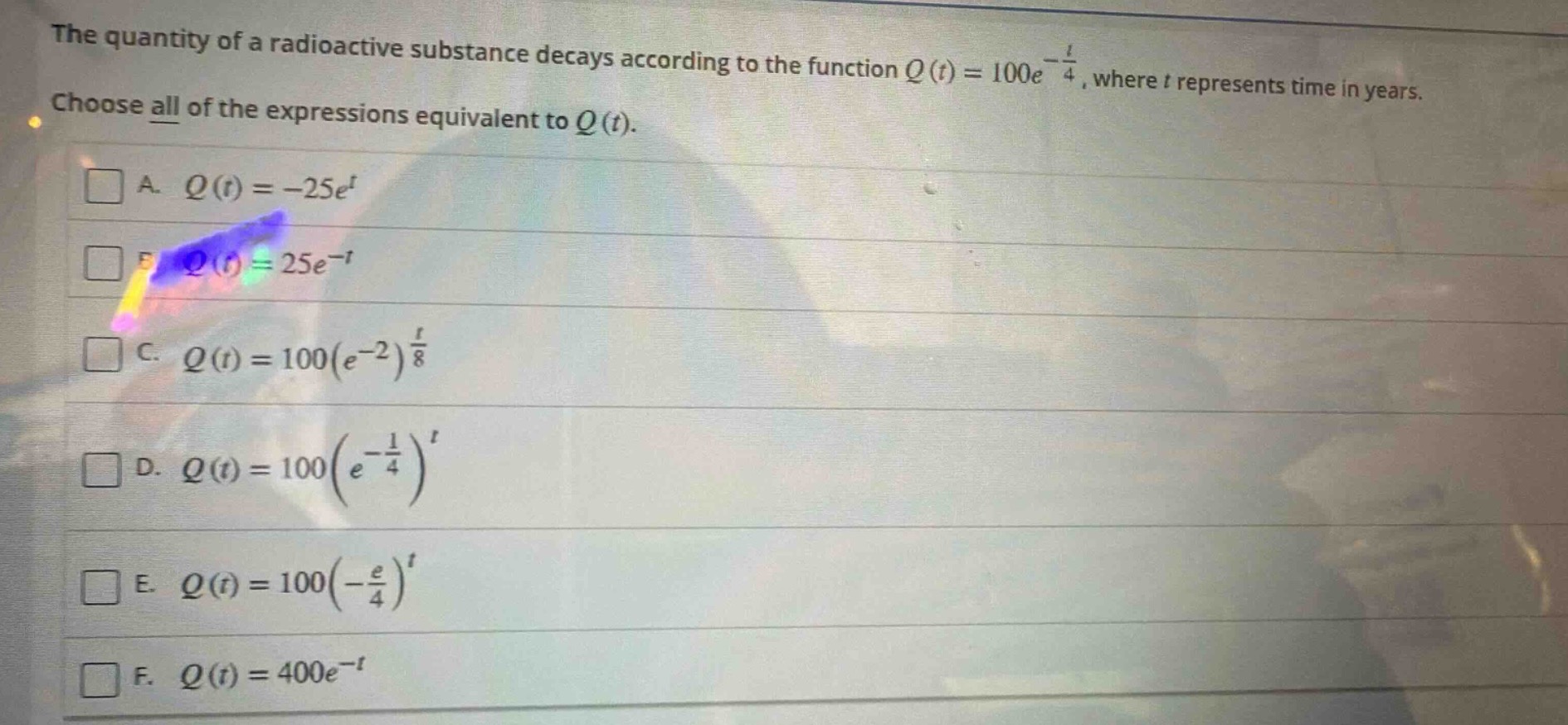
the quantity of a radioactive substance decays according to the function $q(t)=100e^{-\frac{t}{4}}$, where $t$ represents time in years. choose all of the expressions equivalent to $q(t)$. a. $q(t)= - 25e^{t}$ b. $q(t)=25e^{-t}$ c. $q(t)=100(e^{-2})^{\frac{t}{8}}$ d. $q(t)=100(e^{-\frac{1}{4}})^{t}$ e. $q(t)=100(-\frac{e}{4})^{t}$ f. $q(t)=400e^{-t}$
Answer
Explanation:
Step1: Recall exponent rules
Use the rule $(a^m)^n=a^{mn}$.
Step2: Analyze option C
For $Q(t) = 100(e^{-2})^{\frac{t}{8}}$, by the exponent - rule $(a^m)^n=a^{mn}$, we have $(e^{-2})^{\frac{t}{8}}=e^{-2\times\frac{t}{8}}=e^{-\frac{t}{4}}$. So $Q(t)=100(e^{-2})^{\frac{t}{8}} = 100e^{-\frac{t}{4}}$.
Step3: Analyze option D
For $Q(t)=100(e^{-\frac{1}{4}})^t$, by the exponent - rule $(a^m)^n=a^{mn}$, we have $(e^{-\frac{1}{4}})^t=e^{-\frac{1}{4}t}=e^{-\frac{t}{4}}$. So $Q(t)=100(e^{-\frac{1}{4}})^t = 100e^{-\frac{t}{4}}$.
Step4: Analyze other options
- Option A: $Q(t)=-25e^t$ is not equivalent to $100e^{-\frac{t}{4}}$ since the coefficient and the exponent of $e$ are different.
- Option B: $Q(t)=25e^{-t}$ is not equivalent as the coefficient and the exponent of $e$ are different.
- Option E: $Q(t)=100(-\frac{e}{4})^t$ is not equivalent because of the negative sign and the fraction in the base.
- Option F: $Q(t)=400e^{-t}$ is not equivalent due to the coefficient and the exponent of $e$.
Answer:
C. $Q(t)=100(e^{-2})^{\frac{t}{8}}$, D. $Q(t)=100(e^{-\frac{1}{4}})^t$