question 1 of 10\ncarbon - 11 undergoes radioactive decay. which particle correctly completes the equation…
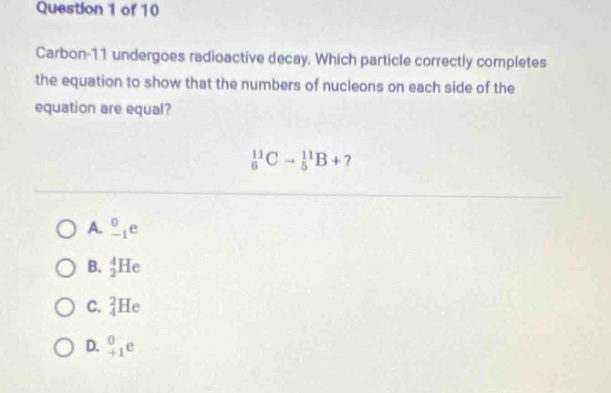
question 1 of 10\ncarbon - 11 undergoes radioactive decay. which particle correctly completes the equation to show that the numbers of nucleons on each side of the equation are equal?\n$_{6}^{11}c\rightarrow_{5}^{11}b +?$ \na. $_{ - 1}^{0}e$\nb. $_{2}^{4}he$\nc. $_{2}^{3}he$\nd. $_{ + 1}^{0}e$
Answer
Answer:
D. $_{+1}^{0}e$
Explanation:
Step1: Analyze mass - number conservation
In a nuclear reaction, the total mass - number (top number) on the left - hand side must equal the total mass - number on the right - hand side. For the given reaction ${6}^{11}C\rightarrow{5}^{11}B +?$, the mass - number of $C$ is 11 and the mass - number of $B$ is 11. So the mass - number of the emitted particle must be 0.
Step2: Analyze atomic - number conservation
The atomic number (bottom number) on the left - hand side must equal the total atomic number on the right - hand side. The atomic number of $C$ is 6 and the atomic number of $B$ is 5. To balance the atomic number, the atomic number of the emitted particle must be $6 - 5=1$.
Step3: Identify the particle
A particle with mass - number 0 and atomic number 1 is a positron, represented as $_{+1}^{0}e$.