question 10 (1 point)\nin which case is negative work done?\na. the work done by earth on a ball as the…
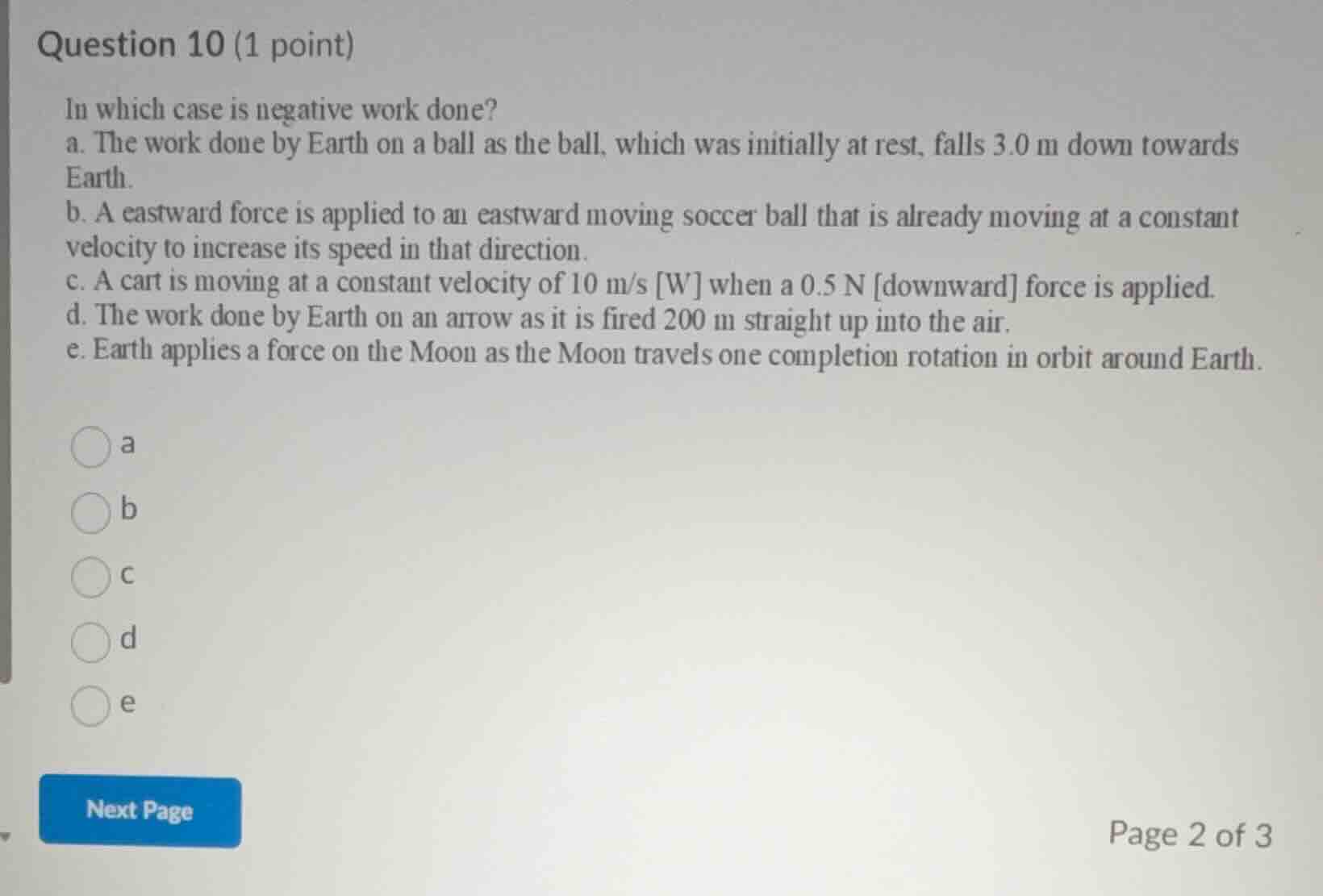
question 10 (1 point)\nin which case is negative work done?\na. the work done by earth on a ball as the ball, which was initially at rest, falls 3.0 m down towards earth.\nb. a eastward force is applied to an eastward moving soccer ball that is already moving at a constant velocity to increase its speed in that direction.\nc. a cart is moving at a constant velocity of 10 m/s w when a 0.5 n downward force is applied.\nd. the work done by earth on an arrow as it is fired 200 m straight up into the air.\ne. earth applies a force on the moon as the moon travels one completion rotation in orbit around earth.\n\na\n\nb\n\nc\n\nd\n\ne
Answer
Brief Explanations:
To determine when negative work is done, we use the formula for work ( W = Fd\cos\theta ), where ( \theta ) is the angle between the force ( F ) and displacement ( d ). Negative work occurs when ( \cos\theta < 0 ), i.e., ( \theta > 90^\circ ) (force and displacement are in opposite directions).
- Option a: The force of gravity (Earth on the ball) and displacement (downward) are in the same direction (( \theta = 0^\circ ), ( \cos\theta = 1 )). Work is positive.
- Option b: The applied force (eastward) and displacement (eastward) are in the same direction (( \theta = 0^\circ ), ( \cos\theta = 1 )). Work is positive.
- Option c: The applied force (downward) and displacement (westward) are perpendicular (( \theta = 90^\circ ), ( \cos\theta = 0 )). Work is zero.
- Option d: The force of gravity (Earth on the arrow) is downward, but the displacement is upward (opposite direction, ( \theta = 180^\circ ), ( \cos\theta = -1 )). Thus, ( W = Fd(-1) ), so work is negative.
- Option e: The gravitational force on the Moon is centripetal (toward Earth), and the Moon’s displacement in orbit is tangential (perpendicular to the force, ( \theta = 90^\circ ), ( \cos\theta = 0 )). Work is zero.
Answer:
d. The work done by Earth on an arrow as it is fired 200 m straight up into the air.