question 2 of 10\nsamples of different materials, a and b, have the same mass, but the sample of b is higher…
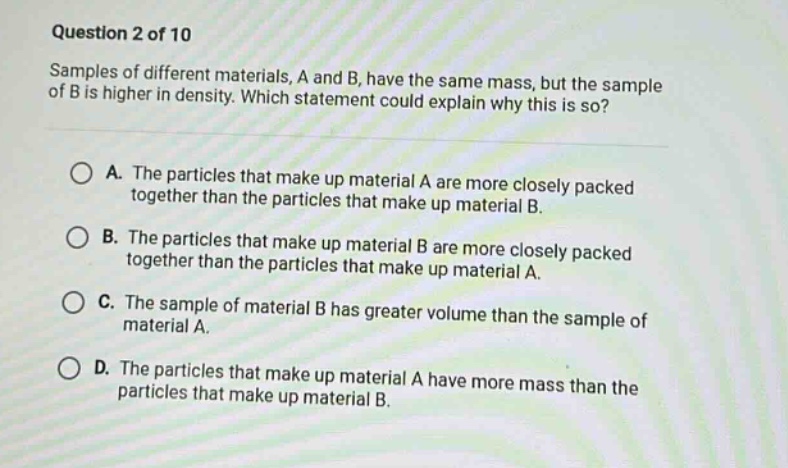
question 2 of 10\nsamples of different materials, a and b, have the same mass, but the sample of b is higher in density. which statement could explain why this is so?\na. the particles that make up material a are more closely packed together than the particles that make up material b.\nb. the particles that make up material b are more closely packed together than the particles that make up material a.\nc. the sample of material b has greater volume than the sample of material a.\nd. the particles that make up material a have more mass than the particles that make up material b.
Answer
Brief Explanations:
Density is defined as mass per unit volume ($\rho=\frac{m}{V}$). Given that materials A and B have the same mass, a higher - density for B means a smaller volume for B (since density and volume are inversely related when mass is constant). More closely - packed particles result in a smaller volume for the same number of particles. So, the particles of material B are more closely packed than those of material A.
Answer:
B. The particles that make up material B are more closely packed together than the particles that make up material A.