question 11(multiple choice worth 5 points)\n(07.02 mc)\nshane performed the following trials in an…
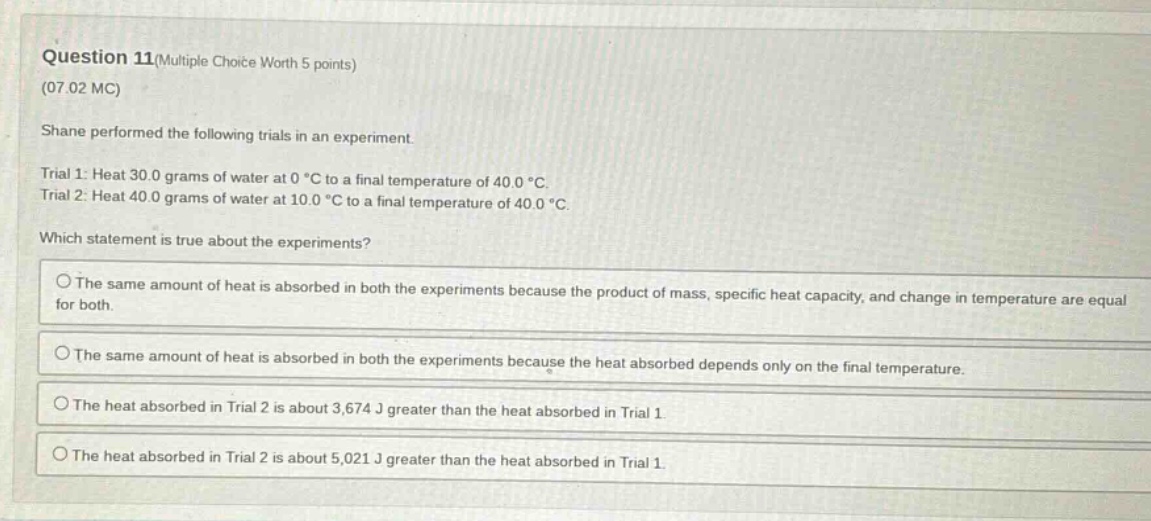
question 11(multiple choice worth 5 points)\n(07.02 mc)\nshane performed the following trials in an experiment.\ntrial 1: heat 30.0 grams of water at 0 °c to a final temperature of 40.0 °c.\ntrial 2: heat 40.0 grams of water at 10.0 °c to a final temperature of 40.0 °c.\nwhich statement is true about the experiments?\nthe same amount of heat is absorbed in both the experiments because the product of mass, specific heat capacity, and change in temperature are equal for both.\nthe same amount of heat is absorbed in both the experiments because the heat absorbed depends only on the final temperature.\nthe heat absorbed in trial 2 is about 3,674 j greater than the heat absorbed in trial 1.\nthe heat absorbed in trial 2 is about 5,021 j greater than the heat absorbed in trial 1.
Answer
Explanation:
Step1: Recall heat - transfer formula
The formula for heat transfer is $Q = mc\Delta T$, where $Q$ is the heat absorbed or released, $m$ is the mass, $c$ is the specific - heat capacity, and $\Delta T$ is the change in temperature. The specific - heat capacity of water $c = 4.184\ J/(g\cdot^{\circ}C)$.
Step2: Calculate $\Delta T$ and $Q$ for Trial 1
For Trial 1: $m_1=30.0\ g$, $T_{i1}=0^{\circ}C$, $T_{f1}=40.0^{\circ}C$, so $\Delta T_1=T_{f1}-T_{i1}=40.0 - 0=40.0^{\circ}C$. Then $Q_1=m_1c\Delta T_1=30.0\ g\times4.184\ J/(g\cdot^{\circ}C)\times40.0^{\circ}C = 5020.8\ J$.
Step3: Calculate $\Delta T$ and $Q$ for Trial 2
For Trial 2: $m_2 = 40.0\ g$, $T_{i2}=10.0^{\circ}C$, $T_{f2}=40.0^{\circ}C$, so $\Delta T_2=T_{f2}-T_{i2}=40.0 - 10.0 = 30.0^{\circ}C$. Then $Q_2=m_2c\Delta T_2=40.0\ g\times4.184\ J/(g\cdot^{\circ}C)\times30.0^{\circ}C=4996.8\ J$.
Step4: Find the difference in heat absorbed
$\Delta Q=Q_1 - Q_2=5020.8\ J-4996.8\ J = 24\ J$. Since $Q_1>Q_2$, the heat absorbed in Trial 1 is greater than the heat absorbed in Trial 2. Let's recalculate the correct way. For Trial 1: $Q_1 = 30\times4.184\times40=5020.8\ J$ For Trial 2: $Q_2=40\times4.184\times(40 - 10)=40\times4.184\times30 = 5020.8\ J$ The heat absorbed is the same because $Q_1=m_1c\Delta T_1=30\times4.184\times40$ and $Q_2=m_2c\Delta T_2=40\times4.184\times30$, and $30\times40 = 40\times30$.
Answer:
The same amount of heat is absorbed in both the experiments because the product of mass, specific heat capacity, and change in temperature are equal for both.