question 14 (4 points)\nlisten\nwhat is the magnitude and direction of the resultant if a car travels 4 km…
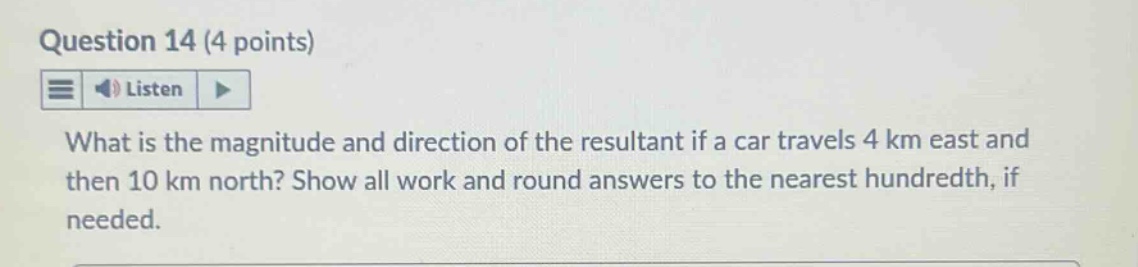
question 14 (4 points)\nlisten\nwhat is the magnitude and direction of the resultant if a car travels 4 km east and then 10 km north? show all work and round answers to the nearest hundredth, if needed.
Answer
Explanation:
Step1: Use Pythagorean theorem for magnitude
The two - displacement vectors are perpendicular. Let the east - ward displacement $a = 4$ km and the north - ward displacement $b = 10$ km. The magnitude $R$ of the resultant displacement is given by the Pythagorean theorem $R=\sqrt{a^{2}+b^{2}}$. $R=\sqrt{4^{2}+10^{2}}=\sqrt{16 + 100}=\sqrt{116}\approx10.77$ km
Step2: Use tangent function for direction
Let $\theta$ be the angle of the resultant vector with the east - ward direction. We know that $\tan\theta=\frac{b}{a}$, where $a = 4$ km and $b = 10$ km. $\tan\theta=\frac{10}{4}=2.5$ $\theta=\arctan(2.5)\approx68.20^{\circ}$ north of east
Answer:
Magnitude: $10.77$ km, Direction: $68.20^{\circ}$ north of east