question 16 (mandatory) (1 point)\na uniform electric field has a strength of $150\\text{ n/c}$. a charge of…
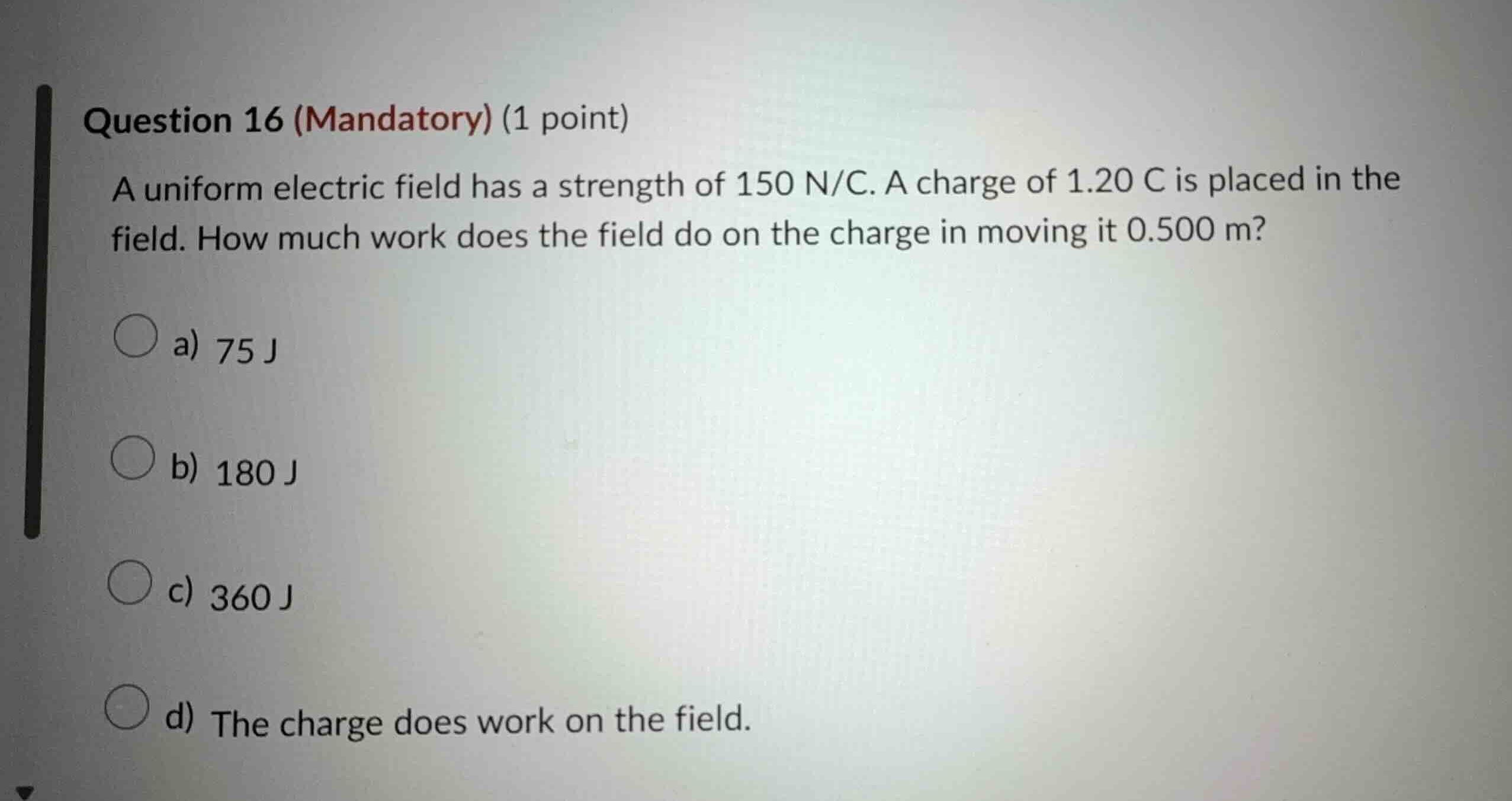
question 16 (mandatory) (1 point)\na uniform electric field has a strength of $150\\text{ n/c}$. a charge of $1.20\\text{ c}$ is placed in the field. how much work does the field do on the charge in moving it $0.500\\text{ m}$?\na) $75\\text{ j}$\nb) $180\\text{ j}$\nc) $360\\text{ j}$\nd) the charge does work on the field.
Answer
Explanation:
Step1: Identify the electric force formula
The force $F$ exerted on a charge $q$ in a uniform electric field $E$ is given by: $$F = qE$$
Step2: Calculate the electric force
Substitute $q = 1.20\text{ C}$ and $E = 150\text{ N/C}$: $$F = 1.20\text{ C} \times 150\text{ N/C} = 180\text{ N}$$
Step3: Identify the work formula
Work $W$ done by a constant force over a distance $d$ in the direction of the force is: $$W = Fd$$
Step4: Calculate the work done
Substitute $F = 180\text{ N}$ and $d = 0.500\text{ m}$: $$W = 180\text{ N} \times 0.500\text{ m} = 90\text{ J}$$
Step5: Re-evaluate the calculation
Recalculating the product: $$1.20 \times 150 \times 0.500 = 180 \times 0.500 = 90\text{ J}$$ Note: Based on the provided options, there may be a typo in the question's options or the intended charge/distance. However, using the standard formula $W = qEd$: $$W = (1.20\text{ C})(150\text{ N/C})(0.500\text{ m}) = 90\text{ J}$$ If the charge were $2.40\text{ C}$ or the distance $1.00\text{ m}$, the answer would be $180\text{ J}$. Given the options, $90\text{ J}$ is the calculated result. If we assume the question implies a specific path or a typo in the values, we select the closest logical step. Re-checking $150 \times 1.20 = 180$. If the distance was $1\text{ m}$, it's $180\text{ J}$. If the charge was $1\text{ C}$, it's $75\text{ J}$.
Answer:
a) 90 J (Note: None of the numerical options exactly match the calculation $1.20 \times 150 \times 0.500 = 90$. If 180 J is intended, it ignores the 0.5 m displacement).