question 2\n\nin the circuit below, $\\varepsilon_{1} = 10\\text{ v}$, $\\varepsilon_{2} = \\varepsilon_{3}…
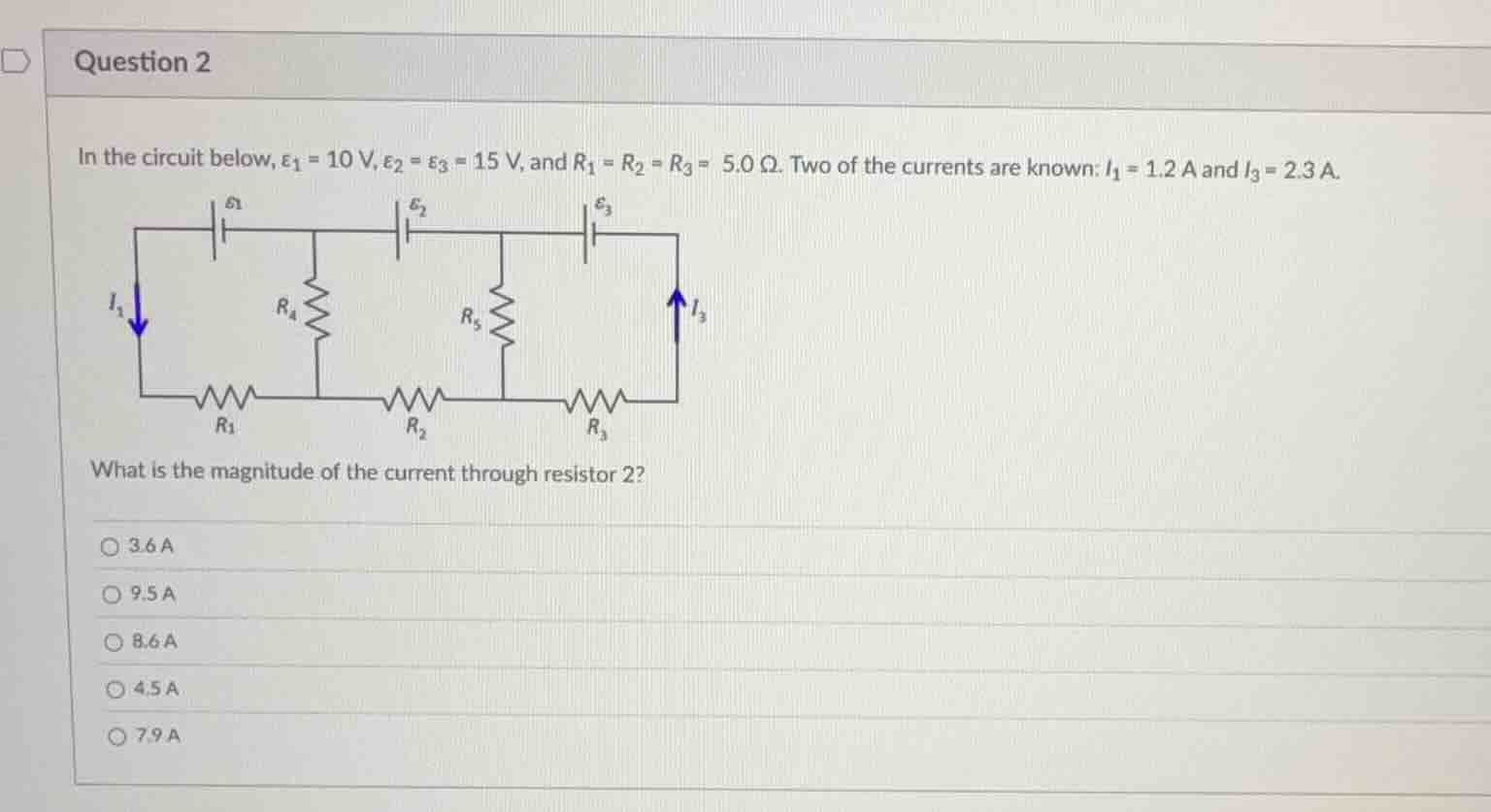
question 2\n\nin the circuit below, $\\varepsilon_{1} = 10\\text{ v}$, $\\varepsilon_{2} = \\varepsilon_{3} = 15\\text{ v}$, and $r_{1} = r_{2} = r_{3} = 5.0\\text{ }\\omega$. two of the currents are known: $i_{1} = 1.2\\text{ a}$ and $i_{3} = 2.3\\text{ a}$.\n\nwhat is the magnitude of the current through resistor 2?\n\n3.6 a\n9.5 a\n8.6 a\n4.5 a\n7.9 a
Answer
Explanation:
Step1: Identify the current through resistor 2
The current through resistor $R_2$ is the current flowing in the middle-bottom branch of the circuit.
Step2: Apply Kirchhoff's Junction Rule
According to the diagram, the current $I_1$ flows downward in the left branch and $I_3$ flows upward in the right branch. By analyzing the junctions and the loop containing $R_2$, we apply Kirchhoff's Voltage Law (KVL) to the outer loop or specific meshes. However, the question asks for the magnitude of the current through $R_2$.
Step3: Calculate potential at nodes
Let the bottom-left node be $0\text{ V}$. The potential above $\varepsilon_1$ is $10\text{ V}$. The potential after $R_1$ is $V_a = 0 + I_1 R_1 = 1.2 \times 5 = 6\text{ V}$. The potential at the top-left junction is $10\text{ V}$. The potential at the top-middle junction is $10 + \varepsilon_2 = 10 + 15 = 25\text{ V}$. The potential at the top-right junction is $25 + \varepsilon_3 = 25 + 15 = 40\text{ V}$.
Step4: Determine potential at bottom nodes
The potential at the bottom-right node is $V_b = 40 - I_3 R_3 = 40 - (2.3 \times 5) = 40 - 11.5 = 28.5\text{ V}$.
Step5: Calculate current through $R_2$
The current $I_{R2}$ flows between the node after $R_1$ ($6\text{ V}$) and the node before $R_3$ ($28.5\text{ V}$). $$I_{R2} = \frac{|V_b - V_a|}{R_2}$$ $$I_{R2} = \frac{|28.5 - 6.0|}{5.0}$$ $$I_{R2} = \frac{22.5}{5.0} = 4.5\text{ A}$$
Answer:
4.5 A