questions:\n7. how does impulse explain the change in momentum of each car during the collision?\n8. why do…
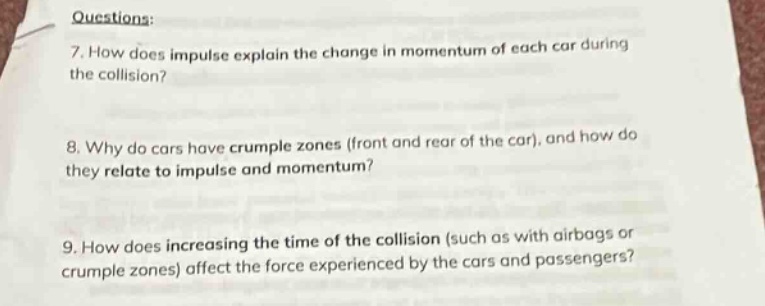
questions:\n7. how does impulse explain the change in momentum of each car during the collision?\n8. why do cars have crumple zones (front and rear of the car), and how do they relate to impulse and momentum?\n9. how does increasing the time of the collision (such as with airbags or crumple zones) affect the force experienced by the cars and passengers?
Answer
Explanation:
Step1: Recall impulse - momentum theorem
Impulse $J$ is defined as the change in momentum $\Delta p$. Mathematically, $J=\Delta p = F_{avg}\times\Delta t$, where $F_{avg}$ is the average force and $\Delta t$ is the time interval. During a collision, the impulse on a car is equal to the change in its momentum. When two cars collide, the force exerted on each car over a short - time interval causes a change in its momentum.
Step2: Explain crumple zones in terms of impulse and momentum
Cars have crumple zones to[Client Connection Error]