quiz viii - 10pts\n4. (quiz viii - 10pts) a frame with mass m₁ = 0.150 kg, when suspended from a coil…
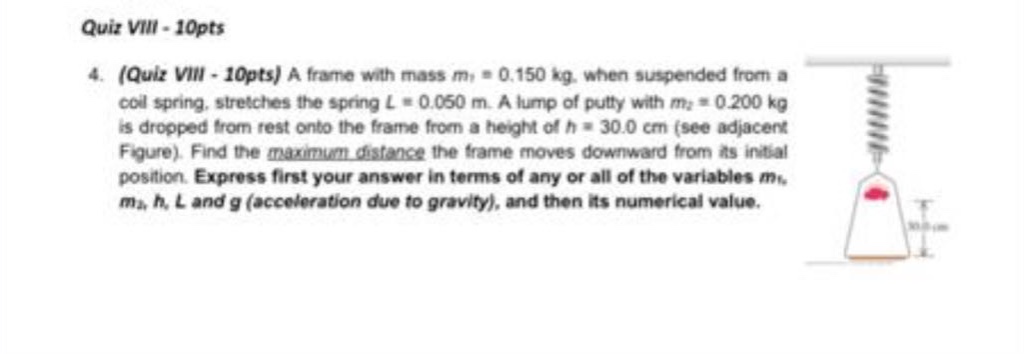
quiz viii - 10pts\n4. (quiz viii - 10pts) a frame with mass m₁ = 0.150 kg, when suspended from a coil spring, stretches the spring l = 0.050 m. a lump of putty with m₂ = 0.200 kg is dropped from rest onto the frame from a height of h = 30.0 cm (see adjacent figure). find the maximum distance the frame moves downward from its initial position. express first your answer in terms of any or all of the variables m₁, m₂, h, l and g (acceleration due to gravity), and then its numerical value.
Answer
Explanation:
Step1: Find the spring - constant k
Using Hooke's law $F = kx$. When the frame of mass $m_1$ is suspended, $m_1g=kL$, so $k=\frac{m_1g}{L}$.
Step2: Find the velocity of the putty just before it hits the frame
Using the kinematic equation $v^2 = v_0^2+2ah$. Here, $v_0 = 0$, $a = g$ and $h$ is the height of the putty's fall. So $v=\sqrt{2gh}$.
Step3: Use conservation of momentum for the in - elastic collision
Let the velocity of the combined mass $(m_1 + m_2)$ just after the collision be $v_1$. By conservation of momentum $m_2v=(m_1 + m_2)v_1$, so $v_1=\frac{m_2\sqrt{2gh}}{m_1 + m_2}$.
Step4: Use conservation of mechanical energy for the motion of the combined mass
Let the maximum additional distance the spring is stretched be $x$. The initial kinetic energy of the combined mass just after the collision is $K=\frac{1}{2}(m_1 + m_2)v_1^2$. The change in elastic potential energy is $\frac{1}{2}k(x + L)^2-\frac{1}{2}kL^2$, and the change in gravitational potential energy is $-(m_1 + m_2)gx$. By conservation of mechanical energy $\frac{1}{2}(m_1 + m_2)v_1^2=\frac{1}{2}k(x + L)^2-\frac{1}{2}kL^2-(m_1 + m_2)gx$. Substitute $k=\frac{m_1g}{L}$ and $v_1=\frac{m_2\sqrt{2gh}}{m_1 + m_2}$ into the above equation and solve for $x$. First, expand the elastic - potential energy terms: $\frac{1}{2}(m_1 + m_2)\left(\frac{m_2\sqrt{2gh}}{m_1 + m_2}\right)^2=\frac{1}{2}\frac{m_1g}{L}(x^2 + 2Lx+L^2)-\frac{1}{2}\frac{m_1g}{L}L^2-(m_1 + m_2)gx$. $\frac{m_2^2gh}{m_1 + m_2}=\frac{m_1g}{2L}x^2+m_1gx-(m_1 + m_2)gx$. $\frac{m_2^2h}{m_1 + m_2}=\frac{m_1}{2L}x^2+(m_1-(m_1 + m_2))x$. $\frac{m_2^2h}{m_1 + m_2}=\frac{m_1}{2L}x^2 - m_2x$. This is a quadratic equation of the form $ax^2+bx + c = 0$ where $a=\frac{m_1}{2L}$, $b=-m_2$ and $c =-\frac{m_2^2h}{m_1 + m_2}$. Using the quadratic formula $x=\frac{-b\pm\sqrt{b^2 - 4ac}}{2a}$, we get: $x=\frac{m_2\pm\sqrt{m_2^2+\frac{2m_1m_2^2h}{(m_1 + m_2)L}}}{\frac{m_1}{L}}$. We take the positive root. Now, given $m_1 = 0.150\ kg$, $m_2 = 0.200\ kg$, $h = 0.30\ m$, $L = 0.050\ m$ and $g = 9.8\ m/s^2$. First, calculate $k=\frac{m_1g}{L}=\frac{0.150\times9.8}{0.050}=29.4\ N/m$. $v=\sqrt{2gh}=\sqrt{2\times9.8\times0.30}\approx2.42\ m/s$. $v_1=\frac{m_2v}{m_1 + m_2}=\frac{0.200\times2.42}{0.150 + 0.200}\approx1.38\ m/s$. Substitute into the energy - conservation equation $\frac{1}{2}(m_1 + m_2)v_1^2=\frac{1}{2}k(x + L)^2-\frac{1}{2}kL^2-(m_1 + m_2)gx$. $\frac{1}{2}(0.150 + 0.200)\times(1.38)^2=\frac{1}{2}\times29.4\times(x + 0.050)^2-\frac{1}{2}\times29.4\times(0.050)^2-(0.150 + 0.200)\times9.8\times x$. $0.33=\ 14.7(x^2 + 0.1x+0.0025)-0.037 - 3.43x$. $0.33=14.7x^2+1.47x + 0.03675-0.037 - 3.43x$. $14.7x^2-1.96x - 0.33025 = 0$. Using the quadratic formula $x=\frac{1.96\pm\sqrt{(1.96)^2-4\times14.7\times(- 0.33025)}}{2\times14.7}$. $x=\frac{1.96\pm\sqrt{3.8416 + 19.1547}}{29.4}=\frac{1.96\pm\sqrt{22.9963}}{29.4}=\frac{1.96\pm4.796}{29.4}$. We take the positive root $x=\frac{1.96 + 4.796}{29.4}\approx0.23\ m$. The maximum distance the frame moves downward from its initial position is $d=x + L$.
Answer:
In terms of variables: $d=\frac{m_2+\sqrt{m_2^2+\frac{2m_1m_2^2h}{(m_1 + m_2)L}}}{\frac{m_1}{L}}+L$. Numerical value: $d\approx0.23 + 0.050=0.28\ m$