both rachel and dominique throw tennis balls into the air. at any time, t, the height, h, of rachels ball is…
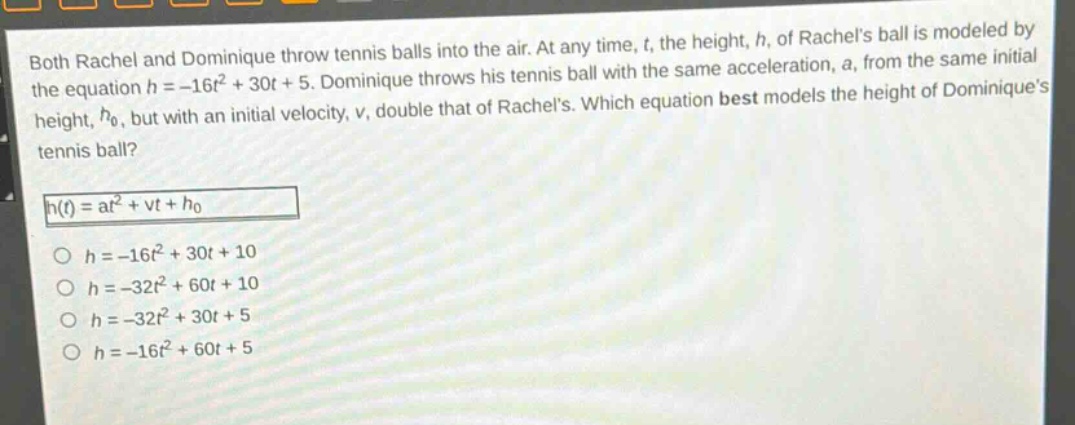
both rachel and dominique throw tennis balls into the air. at any time, t, the height, h, of rachels ball is modeled by the equation h = -16t² + 30t + 5. dominique throws his tennis ball with the same acceleration, a, from the same initial height, h₀, but with an initial velocity, v, double that of rachels. which equation best models the height of dominiques tennis ball?\nh(t)=at² + vt + h₀\no h = -16t² + 30t + 10\no h = -32t² + 60t + 10\no h = -32t² + 30t + 5\no h = -16t² + 60t + 5
Answer
Explanation:
Step1: Identify coefficients for Rachel's ball
For Rachel's ball, the height - time equation is $h=-16t^{2}+30t + 5$. Comparing with $h(t)=at^{2}+vt+h_{0}$, we have $a=-16$, $v = 30$, and $h_{0}=5$.
Step2: Determine coefficients for Dominique's ball
Dominique has the same acceleration $a=-16$ and the same initial height $h_{0}=5$, but the initial velocity is double that of Rachel's. Rachel's initial velocity $v = 30$, so Dominique's initial velocity $v_{D}=2\times30 = 60$.
Step3: Write the equation for Dominique's ball
Substitute $a=-16$, $v = 60$, and $h_{0}=5$ into $h(t)=at^{2}+vt+h_{0}$. We get $h=-16t^{2}+60t + 5$.
Answer:
$h=-16t^{2}+60t + 5$