after a radioactive atom decays, it is the same element that it was before with no measurable change in…
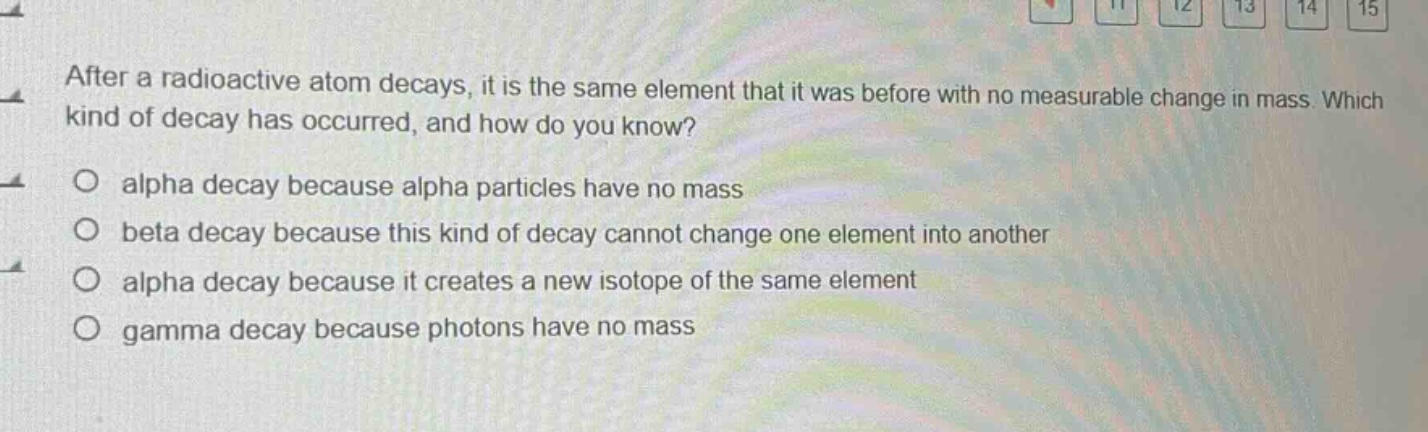
after a radioactive atom decays, it is the same element that it was before with no measurable change in mass. which kind of decay has occurred, and how do you know?\nalpha decay because alpha particles have no mass\nbeta decay because this kind of decay cannot change one element into another\nalpha decay because it creates a new isotope of the same element\ngamma decay because photons have no mass
Answer
Brief Explanations:
Gamma decay involves the emission of gamma - ray photons which have no mass. In gamma decay, the element remains the same and there is no measurable mass change. Alpha decay emits alpha particles (helium - 4 nuclei) which have mass, so it changes the mass and often the element. Beta decay changes the number of protons and neutrons and can change one element into another.
Answer:
D. gamma decay because photons have no mass