radium - 226, a common isotope of radium, has a half - life of 1,620 years. how many grams of a 120 - gram…
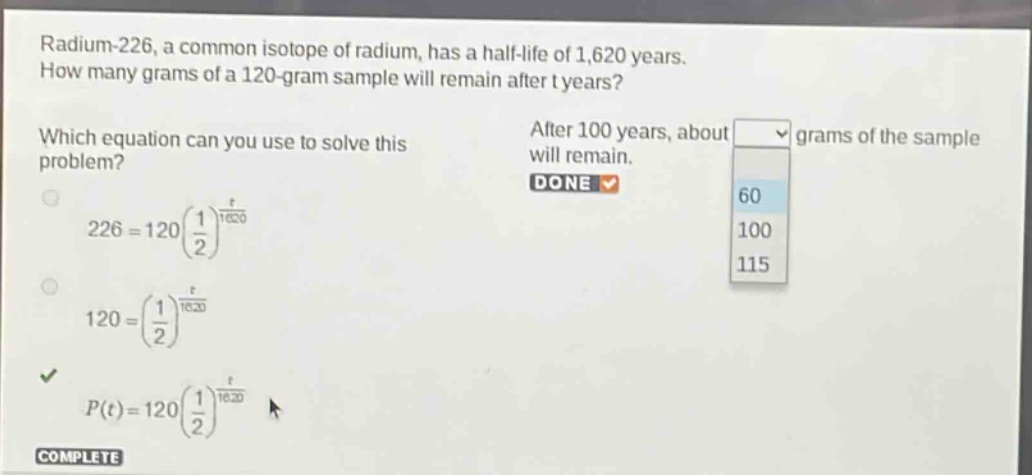
radium - 226, a common isotope of radium, has a half - life of 1,620 years. how many grams of a 120 - gram sample will remain after t years? which equation can you use to solve this problem? 226 = 120(\\frac{1}{2})^{\\frac{t}{1620}} 120=(\\frac{1}{2})^{\\frac{t}{1620}} p(t)=120(\\frac{1}{2})^{\\frac{t}{1620}} after 100 years, about grams of the sample will remain. done 60 100 115 complete
Answer
Explanation:
Step1: Identify the decay - formula
The general formula for radioactive decay is $P(t)=P_0(\frac{1}{2})^{\frac{t}{h}}$, where $P_0$ is the initial amount, $t$ is the time elapsed, and $h$ is the half - life. Here, $P_0 = 120$ grams and $h=1620$ years, so the formula is $P(t)=120(\frac{1}{2})^{\frac{t}{1620}}$.
Step2: Calculate the amount after 100 years
Substitute $t = 100$ into the formula $P(t)=120(\frac{1}{2})^{\frac{t}{1620}}$. So $P(100)=120(\frac{1}{2})^{\frac{100}{1620}}$. First, calculate the exponent: $\frac{100}{1620}=\frac{5}{81}$. Then, $(\frac{1}{2})^{\frac{5}{81}}\approx0.962$. Multiply by the initial amount: $P(100)=120\times0.962 = 115.44\approx115$ grams.
Answer:
The equation is $P(t)=120(\frac{1}{2})^{\frac{t}{1620}}$. After 100 years, about 115 grams of the sample will remain.