the ratio of coils of wire in the primary winding to the secondary winding of a transformer is 3:2. how does…
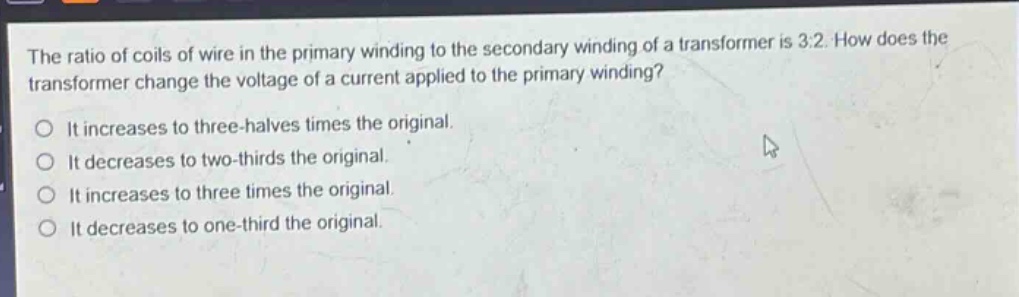
the ratio of coils of wire in the primary winding to the secondary winding of a transformer is 3:2. how does the transformer change the voltage of a current applied to the primary winding?\nit increases to three - halves times the original.\nit decreases to two - thirds the original.\nit increases to three times the original.\nit decreases to one - third the original.
Answer
Explanation:
Step1: Recall the transformer voltage ratio formula
The formula for the voltage ratio in a transformer is (\frac{V_p}{V_s}=\frac{N_p}{N_s}), where (V_p) is the primary voltage, (V_s) is the secondary voltage, (N_p) is the number of turns in the primary winding, and (N_s) is the number of turns in the secondary winding. Given (N_p:N_s = 3:2), so (\frac{N_p}{N_s}=\frac{3}{2}).
Step2: Solve for (V_s)
From (\frac{V_p}{V_s}=\frac{N_p}{N_s}), we can rewrite it as (V_s=\frac{N_s}{N_p}V_p). Substituting (\frac{N_s}{N_p}=\frac{2}{3}) (since (\frac{N_p}{N_s}=\frac{3}{2})), we get (V_s=\frac{2}{3}V_p).
Answer:
It decreases to two - thirds the original.