read the passage.\nac vs. dc\nin the 1880s, the war of the currents began. thomas edison developed direct…
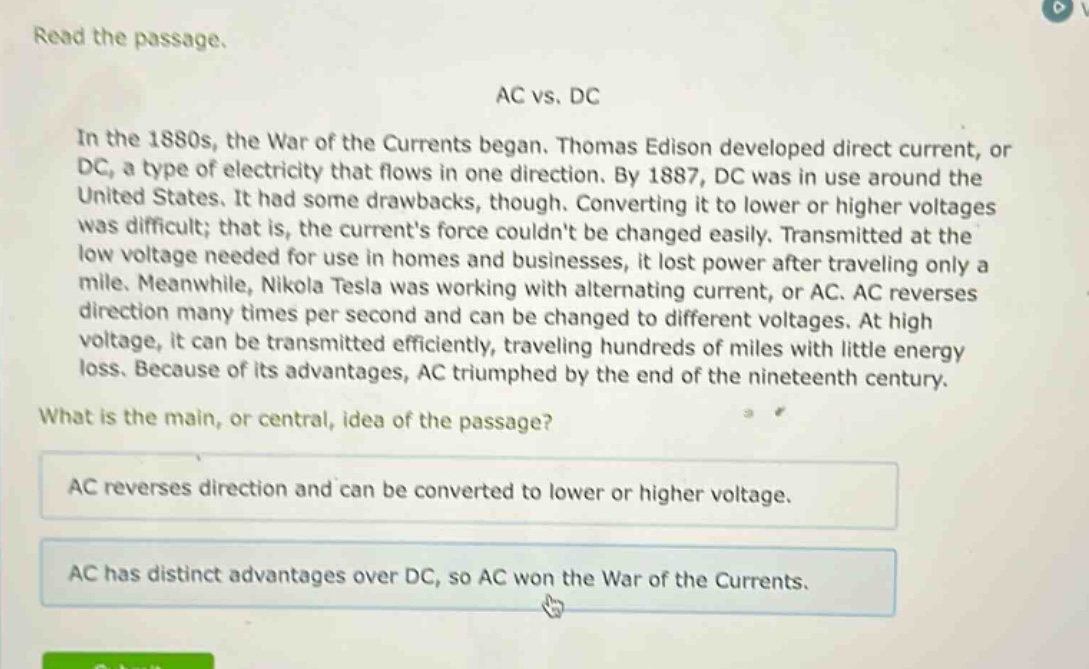
read the passage.\nac vs. dc\nin the 1880s, the war of the currents began. thomas edison developed direct current, or dc, a type of electricity that flows in one direction. by 1887, dc was in use around the united states. it had some drawbacks, though. converting it to lower or higher voltages was difficult; that is, the currents force couldnt be changed easily. transmitted at the low voltage needed for use in homes and businesses, it lost power after traveling only a mile. meanwhile, nikola tesla was working with alternating current, or ac. ac reverses direction many times per second and can be changed to different voltages. at high voltage, it can be transmitted efficiently, traveling hundreds of miles with little energy loss. because of its advantages, ac triumphed by the end of the nineteenth century.\nwhat is the main, or central, idea of the passage?\nac reverses direction and can be converted to lower or higher voltage.\nac has distinct advantages over dc, so ac won the war of the currents.
Answer
Answer:
AC has distinct advantages over DC, so AC won the War of the Currents.
Brief Explanations:
The passage compares DC and AC, highlighting AC's advantages and its victory in the War of the Currents.