read the passage. ac vs. dc in the 1880s, the war of the currents began. thomas edison developed direct…
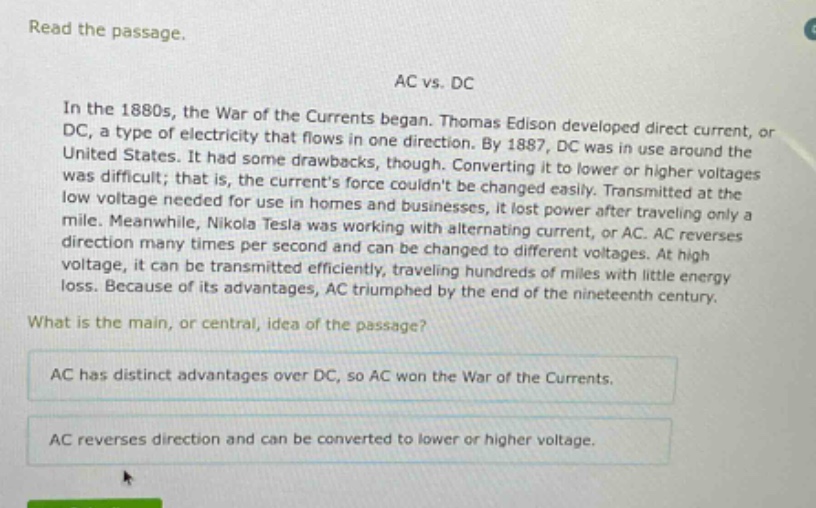
read the passage. ac vs. dc in the 1880s, the war of the currents began. thomas edison developed direct current, or dc, a type of electricity that flows in one direction. by 1887, dc was in use around the united states. it had some drawbacks, though. converting it to lower or higher voltages was difficult; that is, the currents force couldnt be changed easily. transmitted at the low voltage needed for use in homes and businesses, it lost power after traveling only a mile. meanwhile, nikola tesla was working with alternating current, or ac. ac reverses direction many times per second and can be changed to different voltages. at high voltage, it can be transmitted efficiently, traveling hundreds of miles with little energy loss. because of its advantages, ac triumphed by the end of the nineteenth century. what is the main, or central, idea of the passage? ac has distinct advantages over dc, so ac won the war of the currents. ac reverses direction and can be converted to lower or higher voltage.
Answer
Brief Explanations:
The passage first introduces the War of the Currents between DC developed by Edison and AC developed by Tesla. It then lists the drawbacks of DC like difficulty in voltage - conversion and high power - loss during transmission, and the advantages of AC such as easy voltage - conversion and efficient long - distance transmission. Finally, it states that AC triumphed due to its advantages. The first option encompasses the overall comparison and result, while the second option only mentions an advantage of AC without the context of the war and the victory.
Answer:
AC has distinct advantages over DC, so AC won the War of the Currents.