read each scenario and then answer the question. scenario a: a 3 $\frac{n}{m}$ spring is compressed a…
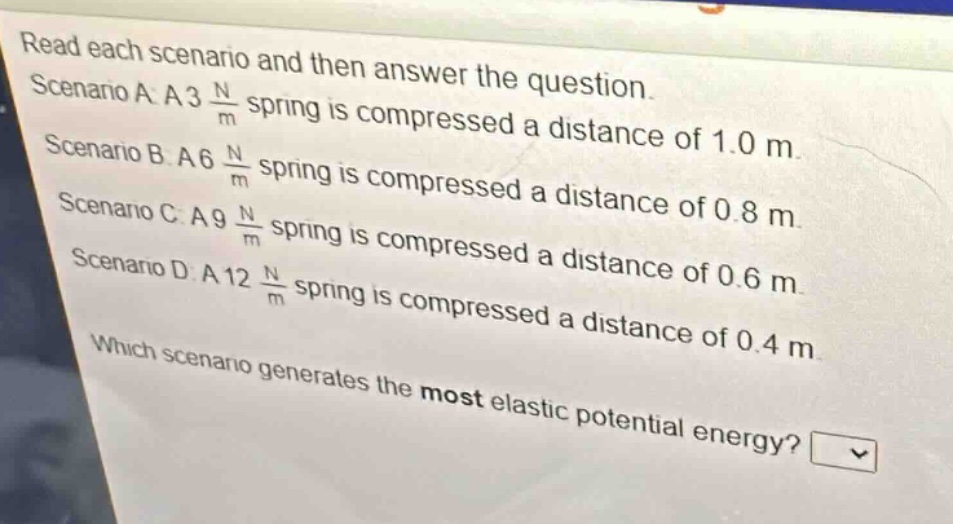
read each scenario and then answer the question. scenario a: a 3 $\frac{n}{m}$ spring is compressed a distance of 1.0 m. scenario b: a 6 $\frac{n}{m}$ spring is compressed a distance of 0.8 m. scenario c: a 9 $\frac{n}{m}$ spring is compressed a distance of 0.6 m. scenario d: a 12 $\frac{n}{m}$ spring is compressed a distance of 0.4 m. which scenario generates the most elastic potential energy?
Answer
Explanation:
Step1: Recall elastic - potential - energy formula
The formula for elastic potential energy is $U = \frac{1}{2}kx^{2}$, where $k$ is the spring - constant and $x$ is the displacement from the equilibrium position.
Step2: Calculate elastic potential energy for Scenario A
Given $k_A=3\frac{N}{m}$ and $x_A = 1.0m$. Then $U_A=\frac{1}{2}\times3\times(1.0)^{2}=\frac{3}{2}=1.5J$.
Step3: Calculate elastic potential energy for Scenario B
Given $k_B = 6\frac{N}{m}$ and $x_B=1.0m$. Then $U_B=\frac{1}{2}\times6\times(1.0)^{2}=3J$.
Step4: Calculate elastic potential energy for Scenario C
Given $k_C = 9\frac{N}{m}$ and $x_C = 0.8m$. Then $U_C=\frac{1}{2}\times9\times(0.8)^{2}=\frac{9}{2}\times0.64 = 2.88J$.
Step5: Calculate elastic potential energy for Scenario D
Given $k_D=12\frac{N}{m}$ and $x_D = 0.4m$. Then $U_D=\frac{1}{2}\times12\times(0.4)^{2}=6\times0.16 = 0.96J$.
Step6: Compare the values
Comparing $U_A = 1.5J$, $U_B=3J$, $U_C = 2.88J$, and $U_D=0.96J$, we can see that $U_B$ is the largest.
Answer:
Scenario B