read through the scenarios below and calculate the predicted change in kinetic energy of the object compared…
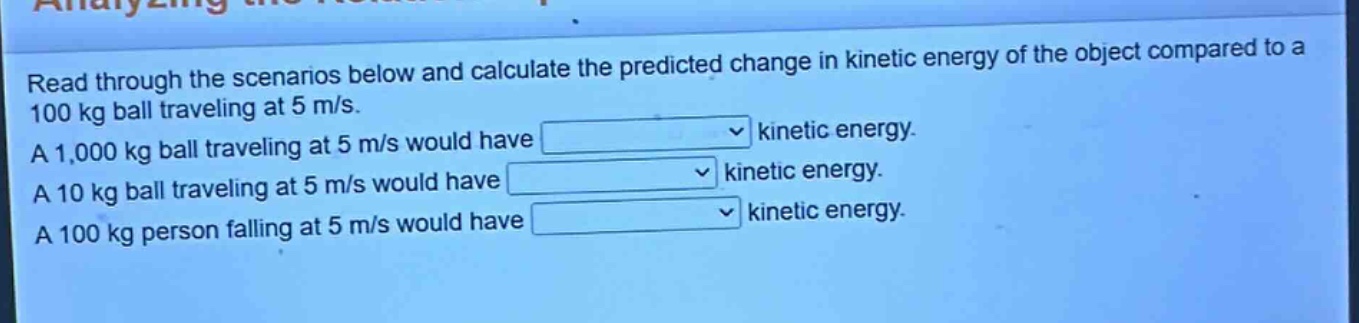
read through the scenarios below and calculate the predicted change in kinetic energy of the object compared to a 100 kg ball traveling at 5 m/s. a 1,000 kg ball traveling at 5 m/s would have kinetic energy. a 10 kg ball traveling at 5 m/s would have kinetic energy. a 100 kg person falling at 5 m/s would have kinetic energy.
Answer
Explanation:
Step1: Recall kinetic - energy formula
The formula for kinetic energy is $KE=\frac{1}{2}mv^{2}$, where $m$ is the mass and $v$ is the velocity. For the reference object, $m_0 = 100$ kg and $v_0=5$ m/s, so $KE_0=\frac{1}{2}\times100\times5^{2}=1250$ J.
Step2: Analyze 1000 - kg ball
For a 1000 - kg ball with $v = 5$ m/s, $KE_1=\frac{1}{2}\times1000\times5^{2}=12500$ J. Since $KE_1/KE_0=\frac{\frac{1}{2}\times1000\times5^{2}}{\frac{1}{2}\times100\times5^{2}} = 10$, it has 10 times the kinetic energy.
Step3: Analyze 10 - kg ball
For a 10 - kg ball with $v = 5$ m/s, $KE_2=\frac{1}{2}\times10\times5^{2}=125$ J. Since $KE_2/KE_0=\frac{\frac{1}{2}\times10\times5^{2}}{\frac{1}{2}\times100\times5^{2}}=\frac{1}{10}$, it has $\frac{1}{10}$ of the kinetic energy.
Step4: Analyze 100 - kg person
For a 100 - kg person with $v = 5$ m/s, $KE_3=\frac{1}{2}\times100\times5^{2}=1250$ J. Since $KE_3 = KE_0$, it has the same kinetic energy.
Answer:
A 1,000 kg ball traveling at 5 m/s would have 10 times the kinetic energy. A 10 kg ball traveling at 5 m/s would have $\frac{1}{10}$ of the kinetic energy. A 100 kg person falling at 5 m/s would have the same kinetic energy.