which represents the balanced equation for the beta minus emission of phosphorus - 32?\n$_{15}^{32}p\\longrig…
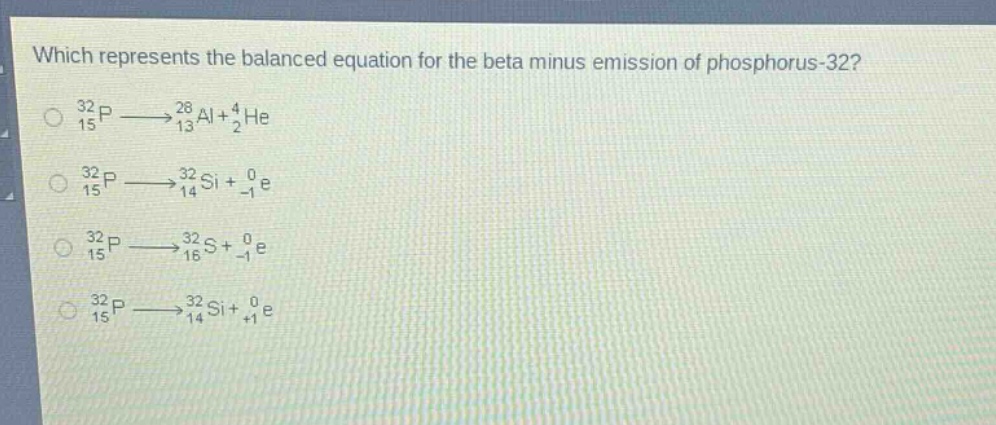
which represents the balanced equation for the beta minus emission of phosphorus - 32?\n$_{15}^{32}p\\longrightarrow_{13}^{28}al + _{2}^{4}he$\n$_{15}^{32}p\\longrightarrow_{14}^{32}si+_{ - 1}^{0}e$\n$_{15}^{32}p\\longrightarrow_{16}^{32}s+_{ - 1}^{0}e$\n$_{15}^{32}p\\longrightarrow_{14}^{32}si+_{ + 1}^{0}e$
Answer
Brief Explanations:
In beta - minus decay, a neutron in the nucleus is converted into a proton, an electron (beta - particle), and an antineutrino. The mass number remains the same and the atomic number increases by 1. Phosphorus - 32 (${15}^{32}P$) has an atomic number of 15 and mass number of 32. After beta - minus decay, the new element will have an atomic number of 16 (sulfur) and mass number of 32, and an electron (${ - 1}^0e$) is emitted.
Answer:
${15}^{32}P\rightarrow{16}^{32}S + _{ - 1}^0e$ (the third option)