when the resistance in a circuit remains constant, how are the voltage and current related?\nthe current…
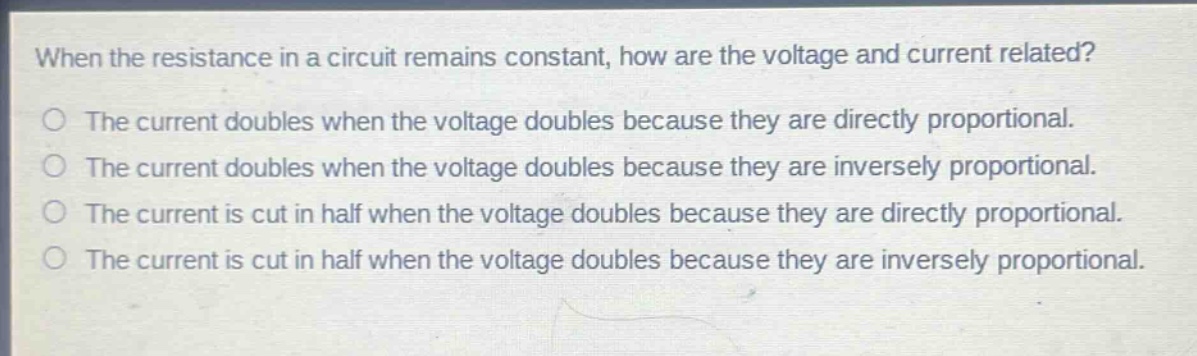
when the resistance in a circuit remains constant, how are the voltage and current related?\nthe current doubles when the voltage doubles because they are directly proportional.\nthe current doubles when the voltage doubles because they are inversely proportional.\nthe current is cut in half when the voltage doubles because they are directly proportional.\nthe current is cut in half when the voltage doubles because they are inversely proportional.
Answer
Brief Explanations:
According to Ohm's law $V = IR$ (where $V$ is voltage, $I$ is current, and $R$ is resistance). When $R$ is constant, $I=\frac{V}{R}$, so $I$ is directly proportional to $V$. If $V$ doubles, $I$ also doubles.
Answer:
The current doubles when the voltage doubles because they are directly proportional.