the resistance, $r$, to electricity of a cylindrical - shaped wire is given by the equation $r =…
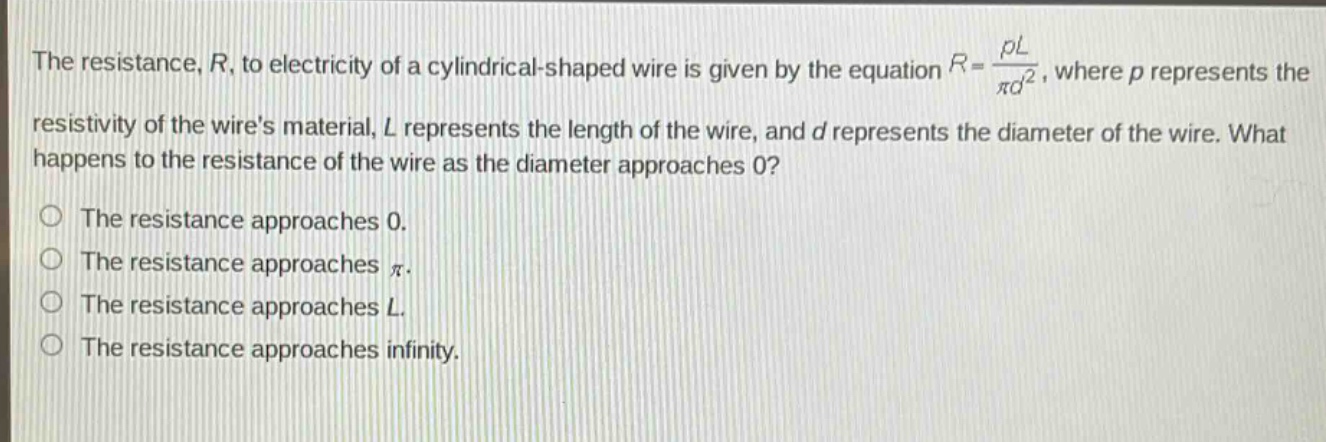
the resistance, $r$, to electricity of a cylindrical - shaped wire is given by the equation $r = \\frac{\\rho l}{\\pi d^{2}}$, where $\\rho$ represents the resistivity of the wires material, $l$ represents the length of the wire, and $d$ represents the diameter of the wire. what happens to the resistance of the wire as the diameter approaches 0?\nthe resistance approaches 0.\nthe resistance approaches $\\pi$.\nthe resistance approaches $l$.\nthe resistance approaches infinity.
Answer
Explanation:
Step1: Analyze the resistance formula
Given $R = \frac{\rho L}{\pi d^{2}}$, where $\rho$ and $L$ are non - zero constants (assuming non - zero resistivity and length).
Step2: Consider the limit as $d$ approaches 0
We want to find $\lim_{d\rightarrow0}\frac{\rho L}{\pi d^{2}}$. As $d$ gets closer and closer to 0, the denominator $\pi d^{2}$ gets closer and closer to 0. Since the numerator $\rho L$ is a non - zero constant, the value of the fraction $\frac{\rho L}{\pi d^{2}}$ gets larger and larger.
Answer:
The resistance approaches infinity.